

Blue Economy and the Need for Maritime Cooperation in the IOR
Introduction
The Indian Ocean Region (IOR) is one of the most populated areas in the world comprising of 21 countries from Asia, Africa and Australia. The region has enormous resources. It contains two third of world’s oil reserves, one third of world’s natural gas, 90% of the world’s diamond, 60% of the world’s uranium and 40% of the world’s gold. All these make IOR as the single largest wealth exploitable area in the world. However, the area had been mostly neglected of its availability of resources, their extraction/ conservation policy and maintenance of environment. As it is said by Micheal Peason,
Countries included here belong to diversified characteristics in terms of culture, economy, race, religion, etc. The level of political stability, the quality of governance, demographic pressures, ethnic and sectarian tension, and the peace of economic growth often create a different mix of opportunities and challenges in each state. This phenomenon is likely to affect development goals and sustainable strategic plan of a country in the IOR. For these maritime regimes to be effective, the Indian Ocean must be considered as ‘One Ocean, One Region’.
In 1997 some of the countries in the region formed Indian Ocean Rim Association (IORARC) with an aim to promote greater economic interaction, socio-economic cooperation and human resource development around the region. However, it seemed that the organization could not fulfill the net objectives till today. In the recent days the Blue Economy concept has evolved which defines the regulated extraction of the resources at and from the sea and also to ensure green environment. The Blue Economy concept is comparatively new one and probably no one country singly can perform optimum. Because of the presence of enormous resources in IOR, countries need to take initiative to adopt Blue Economy concept in the area. In this paper the different aspects of Blue Economy and the need for maritime cooperation in the IOR area will be analyzed in details with an aim to propose for a comprehensive maritime solution.
Blue Economy Genesis and its Concerns
As per SIDS (Small Island Development Studies) concept paper‘Blue Economy’ is marine-based economic development that leads to improved human well-being and social equity, while significantly reducing environmental risks and ecological scarcities. It includes: Reframing the oceans as ‘Development Spaces’ that are subject to spatial planning. To put it simply Blue Economy is often referred to as the economic involvement in the maritime arena in an effective way. As per the opinions of several maritime scholars, the Blue Economy concept has a lot to offer specially to the small nations. Littorals of IOR are not exceptions. The definition identifies two separate entities namely the marine-based economic development and reducing environmental risks including ecological scarcities.As such the Blue Economy concern in the Indian Ocean Region may cover the following broad areas:
- Secured maritime environment for uninterrupted economic activities in the sea.
- Conservation of depleting bio-diversity and marine life.
- Direct impact in the economic wellbeing of the coastal area population.
- Coordinated and measured extraction of living and non-living resources from sea.
- Sea awareness including ocean education.
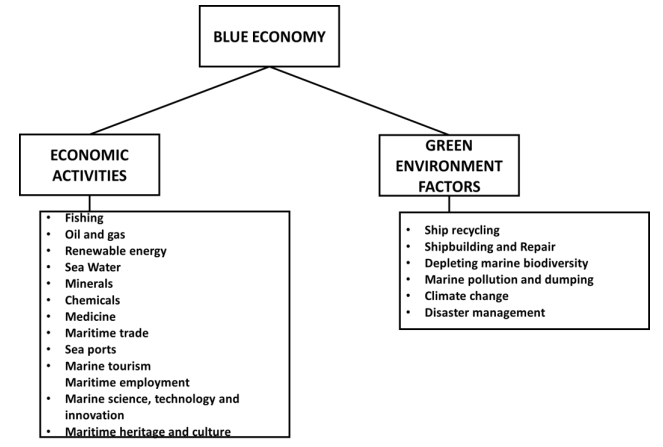
The Blue Economy concerns as mentioned in figure 1 are defined under two broad categories. Their ingredients are important to be comprehended first.
a. Marine-based Economic Development
(1) Fishing and Aquaculture
Indian Ocean is rich in fishes and other aqua substances. Deep sea fishes are found in plenty in this area.The protein requirement of general people is met by the enormous fish catches in the sea. This reduces pressure on sweet water fishes being produced in the ponds and lakes. Aquaculture refers to culturing of ocean species like oysters, clams, shrimp, sea bass, sea bream, etc. Another common living resource is seaweed. It is dried, powdered and mixed with other meals to enrich the fodder with minerals and iodine. It also acts as useful soil conditioner, green manure and fertilizer. When these are managed well a coordinated extraction of the living resources can be made from the IOR. Technical and infrastructural supports would be necessary in this respect. This demands initiative from all the littorals of the IOR.

(2) Oil and Gas
Each of the developed, developing and under developed countries is in need for energy. IOR is a mixture of all these types of countries. In addition to this material production and processing is increasing in the IOR. Therefore, the power and energy requirement is very high in this area. Energy production demands for effective exploration of oil and gas from the Indian Ocean. It is a complex affair and requires technical knowhow. Therefore, a coordinated effort in this respect amongst the countries would reap the desired result. Coordination in respect to Blue Economy will ensure the safe transportation of the resources to different places of interest.
(3) Renewable Energy
The vast sea area of the IOR has great potential for renewable sources of energy in the form of ocean thermal energy, waves, tides and salinity gradients. With the environmental risks of producing non-renewable energy, countries of IOR need to shift focus. There is a good opportunity for the application of wind mills for pumping and electricity generation in the coastal areas.
(4) Sea Water
Sea water itself is an enormous resource. Sea water can be used for aquaculture of sea living resources. In many countries the sea water is let in to the artificial ponds for production of edible salt and sea creatures like shrimp/ crabs, etc. Sea water is also a large source of fresh water after appropriate desalinization. Dry countries may process the sea water for drinking, irrigation and other industrial purposes. Having considerably long coastline, the IOR countries may endeavor to explore sea water resource.
(5) Minerals
Natural gas and oil have been extracted from the seas for decades, but the ores and minerals deposit on the sea floor have attracted little interest over the past which has a lot to offer. After the demarcation of sea boundaries,a huge area of opportunity has been opened to littorals of Indian Ocean. A country may develop salt industry along the coastal areas which has the potential for exports. She can also take measures to extract gas hydrates, polymetalic manganese nodules commercially from the adjacent sea areas. Indications are there that poly-metalic sulfide and cobalt based ferro-manganese crust are available in the EEZ and the continental shelf which need to be looked into. Large quantities of zircon, elemonite, reutiles, etc may be found in the coastal belt which needs to be extracted. However, it shows clearly that the technological backwardness actually hinders uninterrupted extract of these minerals from the sea areas. So is the truth for most of the countries of the IOR. When managed well, the IOR countries would be able to extract many other minerals like ferro-manganese, iodine, magnetite, garnet, zircon, retile, limonite, monazite, etc from the Indian Ocean.
(6) Chemicals
Out of sixty elements present in sea water, only six are being recovered commercially at present around the globe. Greater possibilities are there for deriving some new chemicals like Potassium, Iodine, Uranium and Gold from sea. Though the extraction of these chemicals from sea is much expensive and demanding than that of extracting from land, but still the possibility cannot be ignored. Developing countries of IOR have a huge opportunity here to exploit for theirprogressive economic well-being.
(7) Medicine
Extraction of drugs/medicine from ocean is a century old business. At present about 2000 organisms in the marine kingdom are known to be poisonous or venomous. Many varieties of algae and seaweed are used in food, cosmetics and drug industries. The most remarkable feature is the antifertility properties of several marine organisms. Recently prostaglandins, which play a major role in controlling biological reproduction, have been isolated from seaweed. The utilization of marine plants and animals as raw material for effective and safe drugs and medicine is not very widely made in the countries of IOR comparing to other industries. It seems that very soon countries are likely to go for exploration of these resources from the sea.
(8) Maritime Trade
Waterways throughout the world had been playing a significant role in the development of trade and industry which is no different in case of IOR countries. Being the cheapest method of transportation most of the external trade travels by sea. Many countries depend on almost total import of fuel, industrial raw material, spares and military hardware, as well as the export of finished products to be transported through the sea. As such, uninterrupted maintenance of Sea Lines of Communication (SLOC) is essential for the economic survival of a country.Being developing and economically promising countries of 21st century, the IOR states are likely to have substantial increased requirement of sea trade in the coming days.
(9) Sea Ports and Port Infrastructures
Countries areconnected with the rest of the world through its sea ports and ships. Existence of efficient sea ports and port infrastructures allows a country to prosper enormously in terms of economic development. The frequency of ship cargo handling at port indicates the promising economic development for a nation. A large number of cargoes traverse inter continent through the IOR. Therefore, it is needless to say that the sea ports and port infrastructures of the area need to be paid enough attention. Technology transfer, exchange of skilled manpower and information sharing may lead to an efficient development of these infrastructures.
(10) Marine Tourism
The economic benefits of spreading tourism beyond the major gateways are considerable and there is significant potential for its growth in the IOR. Tourism industry is gradually gaining momentum in this area. In addition to this, other industries related to the tourism like hotels and airlines have flourished which has good impact on the economy. However, a more sustained and planned approach needs to be adopted where funding for ‘hard’ infrastructure such as interpretive centers and ‘soft’ infrastructure such as skill development and training will be required.
(11) Maritime Employment
Maritime domain of the IOR offers huge employment opportunity which is already a substantial job market for the littorals. Almost 20 million people live on sea-based activities in this region. Maritime cluster includes many mega sectors of economic importance related to shipping, ports, shipbuilding, ship recycling, fisheries, tourism, offshore and coastal renewable energy. All of which are strong potential growth sectors in the IOR countries.
(12) Marine Science, Technology and Innovation
The national maritime interests of a country may be best preserved by the achievement of excellence in national marine science through pure and applied research on marine issues. It also improves the technological levels of marine services. IOR littorals should pay attention to the basic marine research and innovations and development of newer technologies to support the individual national maritime activities. They should speed up promotion and utilization of advanced and applicable marine technologies such as instruments and sensors for study of the sea and oceanic spaces. This would promote research on blue biotechnology and genetic resources to develop fishery, aquaculture, underwater robotics,etc and ensure continuous scientific research on non-living resources into the continental shelf, exclusive economic zone, territorial seas, inland waters and marine ecosystem.
(13) Maritime Heritage and Culture
IOR houses countries rich in maritime heritage. Coastal and island countries have high dependence on oceans and it becomes peoples’ central to survival and part of culture. Since long people around this area had been earning their livelihood from the sea. It also facilitates the global trade and commerce providing a cheap and easiest way to traverse. This phenomenon gave rise to a strong maritime tradition too. The festivals and celebrations in this area revolved around the sea condition. A good catch or fair weather brings delight in the life of sea farers. Similarly the opposite situation makes them suffer even for their daily livelihood. A sustainable blue economy concept will uphold the collective maritime heritage and culture for the region keeping intact individual country’s own customs and traditions.
b. Reducing Environmental Risks and Ecological Scarcities
(1) Ship Recycling
Asian countries hold about 94% of total ship recycling of the world. Majority of the developing country’s steel re-rolling industries are run in this area. Ship recycling industry has important contribution in the industrial progress of a country. However, the ship breaking yards and material disposals are issues relatedto environmental pollution and labour safety which need to be looked into. Through Blue Economy concept this environmental risk need to be managed well for efficient running of ship recycling in the IOR countries.

(2) Shipbuilding and Repair Facilities
Shipbuilding is a booming sector for the IOR countries in the recent days. Availability of the raw materials had been a long possessed inherent capability for the countries in this area. However, set back in terms of technological know how never allowed most of the countries here to flourish as shipbuilding nation. In the last decade the countries of this area have become efficient enough in terms of human resource development especially in the technological sectors and in the careful planning in technology transfer from the shipbuilding nations. However, a great deal of risks involved here in terms of raw material processing, waste disposal and safe working environment for the workers. Blue Economy concept needs to encompass a comprehensive roadmap for ensuring a safe condition in ship building industries.
(3) Depleting Marine Biodiversity
Environmental pollution, climate change, salinity change and human aggression significantly affect the marine biodiversity in the coastal areas. Littorals of IOR are likely to be affected from all these factors frequently. A comprehensive Blue Economy framework should be able to minimize the effects of the marine biodiversity by reducing environmental pollution and addressing climate and salinity change in the IOR.
(4) Marine Pollution and Dumping
Due to lack of surveillance and monitoring a lot of unwanted activities take place in the IOR sea areas. Marine pollution and dumping of hazardous materials by human beings are the important concerns in this regard. Stopping of these activities in the sea area requires coordination amongst the nations and collaborative surveillance of the distant sea areas.
(5) Findings
Discussion in this segment shows the extreme potentiality of Blue Economy resources in the IOR. Besides, the IOR suffers from marine environmental hazards which would result in depletion of marine life in the area. Absence of a regulated and comprehensive framework, countries of IOR would not be able to reap expected benefits.
Existing Maritime Cooperation in the IOR
Maritime cooperation in the IOR is a strong felt demand. A number of initiatives were taken in the past in this regard. However, Blue Economy as recently evolved and has a large maritime interest concern may bring the IOR nations together. Some of the existing maritime cooperation in the IOR are as follows.
a. Indian Ocean Naval Symposium (IONS)
The ‘Indian Ocean Naval Symposium’ (IONS) is a voluntary initiative that seeks to increase maritime co-operation among navies of the littoral states of the Indian Ocean Region by providing an open and inclusive forum for discussion of regionally relevant maritime issues. In the process, it endeavors to generate a flow of information between naval professionals that would lead to common understanding and possibly cooperative solutions on the way ahead. There are 35 membernavies in the IONS which have been geographically grouped into the following four sub-regions:
- South Asian Littorals: Bangladesh, India, Maldives, Pakistan, Seychelles and Sri Lanka.
- West Asian Littorals: Bahrain, Iran, Iraq, Kuwait, Oman, Qatar, Saudi Arabia, UAE and Yemen.
- East African Littorals: Comoros, Djibouti, Egypt, Eretria, France, Kenya, Madagascar, Mauritius, Somalia, South Africa, Sudan and Tanzania.
- South East Asian and Australian Littorals: Australia, Indonesia, Malaysia, Myanmar, Singapore, Thailand and Timor Leste.
The IONS has the focus on naval interaction and exchange of information and thoughts with each other. However, it would be prudent to utilize this potential platform merging with Blue Economy effort in the area. As navies are already in a developing stage on safety and security issues here, they can be beefed up by maritime organizations and government concerns for the implementation of Blue Economy concept. Therefore, a part of IONS may deal with Blue Economy concept of IOR.
b. Indian Ocean Rim Association (IORA)
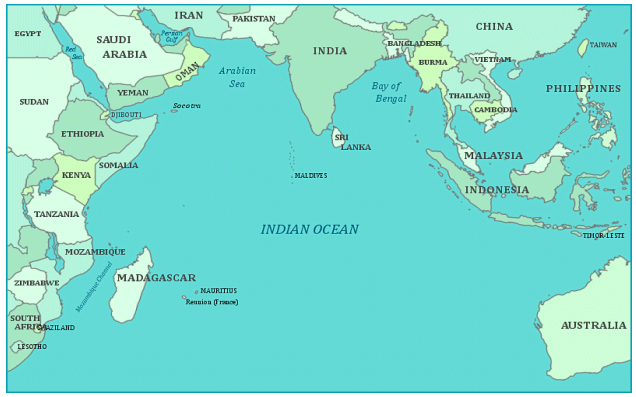
The Indian Ocean Rim is a region comprised of the states whose shores are washed by the waters of the Indian Ocean.They may also be divided into a number of sub-regions (Australasia, Southeast Asia, South Asia, West Asia and Eastern & Southern Africa), each with their own regional groupings (such as ASEAN, SAARC, GCC and SADC, to name a few). IORA is an organization meant for the maritime collaboration and cooperation amongst the member states of the Indian Ocean. However, due to several conflicting issues the organization could not serve in an optimum way. On 4-5 May 2015, at Durban, an IORA Blue Economy Core Group workshop was conducted promoting fisheries and aquaculture and maritime cooperation in the IOR. There were total six sessions in the workshop which in nutshell recommended the followings:
- Identify key focus areas of Blue Economy for future development and collaboration which would include short term (fishing and aquaculture) and long term (shipping, oil and gas exploration) plans.
- Develop more fishing agreements bilaterally and sub-regionally and develop capacity building program on fishing techniques, marketing and export of fish and aquaculture.
- Develop common contact point for information sharing on maritime safety and security issues among maritime security agencies in the IOR.
- Undertake research on Blue Economy and develop comprehensive maritime plan.
Outcome of this workshop were fed to the Committee of Senior Officials (CSO) meeting in Mauritius 28-29 May 2015 after agreeing by the member states of the IOR. However, it is seen that the initiative in fact focused on a very narrow scope for initial implementation namely fish and aquaculture and safety and security. The vast areas of Blue Economy certainly demand a more comprehensive outside in approach for collective economic and environmental well being of the region.
c. Combined Task Force 150, 151 and 152
Combined Task Force 150 (CTF150) is a multinational coalition naval task force working under the 25 nation coalition of Combined Maritime Forces. It is established to monitor, inspect, board and stop suspect shipping to pursue the ‘Global War on Terrorism’and in the Horn of Africa region (HOA). It includes operations in the North Arabian Sea to support operations in the Indian Ocean. Similar kinds of efforts are also taken up by CTF-151 and CTF-152. Areas of responsibilities of CTFs are shown in figure 5.

7. Findings
The security aspect of Blue Economy is an inseparable one which is required to be looked after by the Navies of the area. Therefore, this endeavours need to be upgraded and fit into Blue Economy requirement of the area sub-regionally and regionally.
New Requirements for the Blue Economy Concept
From the analysis of Blue Economy genesis, it shows that the concept is likely to be adopted very soon by the littorals of the IOR. In addition, it is also revealed that existing several initiatives for maritime cooperation requires to be upgraded with some new requirements. Therefore, for effective use of Blue Economy a comprehensive framework need to be designed. Followings are some new requirements rose up for a Blue Economy concept:
- Collective Security Measures. Beside the existing regular maritime cooperation amongst the nations it is important to sort out a collective security measure amongst the littorals of IOR. In the present days and in foreseeable future non state actors would be more threatening than the conventional threats. This will demand the possession of arms and equipment suitable to combat those non-traditional threats. Countries will be required to incorporate security measures in a collective way subregionally and regionally.
- Effective Transportation. Maritime trade plays a vital role in the upholding of country’s economy. For the sake of Blue Economy, an effective transportation through the sea should be planned and ensured. Indian Ocean facilitates regional countries for sea borne trade and transportation. A collective approach in terms of security measures, search and rescue and information sharing will ensure IOR countries effective transportation.
- Clear Maritime Delimitation. For an effective extraction of blue economy maritime boundaries should be demarcated as soon as possible through all possible measures. UNCLOS-III delineates the rules and regulations for resolving the maritime boundaries between the countries. However, because of conflicting interests of individual nations and historical possession at times it becomes difficult to solve the issues. Thereby countries are deprived of extraction of sea resources at right time. Clear maritime delimitation amongst the IOR littorals will aid to have well organized management of sea borne resources.
- Identification of IUU (Illegal, Unreported and Unregulated) Fishing. It is imperative to identify all kinds of irregular activities in the IOR. This entails incorporation of equipment based identification system to be adopted by the port authorities and navies. Automatic Identification System (AIS), registering of fishing vessels and abiding by rules and regulations are some of the methods for identifying and monitoring illegal fishing. Unregulated fishing will deprive all the IOR countries from sufficient fish catch in near future.
- Monitoring Sea Activities. Naval ships are the best platforms for monitoring the sea areas against any illegal activities. In addition to that naval aviation may monitor and carry out surveillance in the sea areas within lesser time spent. The same can also be performed by capable Air Force assets. These activities will ultimately complement to the Blue Economy adoption in the IOR.
Likely Challenges
There lie a number of challenges on the way to adopt the new requirements for an effective Blue Economy concept by the IOR countries. Followings are inclusive in this regard:
- Over Fishing. A large population of developing countriesdepends on fishing from the sea. In fact, in the coastal areas livelihood of people revolve around fishing from the sea. The business of fishing trawlers, net and booms manufacturing, dried fish, fish export, etc depend on fishing from the sea. Besides, it fulfills the nutrition requirement of the population of a country. Therefore, there is likelihood of overfishing at sea for maintaining the livelihood of people. The fishermen are to be regulated accordingly so that over fishing does not take place in the sea. A collective clear strategy is required to be adopted in this regard.
- Lack in Surveillance and Monitoring Effort. The vast sea areas of IOR countries mostly lack surveillance effort. This happens because of lack of appropriate surveillance platforms and equipment.However, it is really difficult for a particular nation to take up comprehensive surveillance effort in their entire EEZ. Therefore, a collective effort for EEZ surveillance may be taken up by a common monitoring body participated by sub-regional/ regional countries.
- Undefined Maritime Boundary. As mentioned earlier the main cause of conflicts at sea roots down to undefined maritime boundary amongst the nations of the IOR. Many of the cases are unresolved and left aside without much attention. Those are required to be dealt first as per the customary maritime laws and legislations.
- IUU Fishing. Developing countries heavily depend on fishing in the sea areas. An unhindered fishing environment ensures proper supply of protein and nutrition to populace of a country. UNCLOS-III, 1982 codifies the right of land locked countries also in the high seas in this respect. Unregulated fishing therefore becomes a barrier in an unmonitored sea area. Blue Economy concept would be challenged by the IUU fishing as its actors seldom would realize any benefit from the adopted concept.
- Lack of Maritime Education. Most of the countries lack in maritime education. Such education is missing from school level to universitylevel. Therefore, the sea farers generally take a particular kind of adhoc training before being involved into marine activities. Many of them also work only on their experience. Which may become at times life threatening, especially in works like ship breaking, sea faring, etc.However, the introduction of maritime education encounters some challenges. People going for maritime education need to be employed satisfactorily after they pass out from the institution which is not easy. Therefore, introduction of maritime education demands for creating sufficient maritime job opportunity in the country.
- Conflicting Interests among the Littoral Countries. Though littoral countries have many common interests involving the sea, yet they may have a number conflicting interests as well. Mostly these are emanating from un-demarcated maritime boundaries. The conflicts result in fishing, extraction of natural resources, shipping, straits and so on.Sometimes, the conflicting interests may originate from political, strategic or security issues. Military cooperation in fact hinders an individual country’s self decided growth in military aspect. However, some of the threats like non-traditional threats from non-state actors require to be addressed by the country herself and which requires own capability development. A country may aspire to develop her own maritime and military capabilities side by side to the regional/ sub-regional cooperation. For all these reasons an IOR nation will remain in dilemma whether to go for maritime cooperation or not. And if yes, how much to emphasize on collaborative development vis-à-vis own capability development.For effective utilization of Blue Economy it is necessary to eliminate conflicting interests amongst the nations.
- Climate Change. It is well known by now that combating climate change would be one of the most important concerns in the coming decade. IOR littorals have the similar threat from this natural phenomenon which is compounded by human actions. Inundation of the coastal areas, effects on marine biodiversity and ground salinity are some of the mentionable impacts in this regard. Blue Economy concept requires considering climate change causes and effects for minimizing its adverse effects.
- Natural Disaster. Coastal nations of IOR will remain prone to frequent and intense natural disasters. Cyclone, storm, tsunami are common phenomenon in these countries. The peculiar characteristics and vulnerabilities make it especially difficult for them to realize sustainable development. Challenges from natural disasters may be addressed by appropriate warning system, ready response, preparation before the disaster and post disaster management. A comprehensive Blue Economy concept should be able to address issues of disaster management in the regionthrough a collaborative approach.
- Food Insecurity. Except few countries, others of IOR suffer from food insecurity to some extent. This entails that they would remain exploratory for ensuring the need of their own country people. A sustainable blue economy concept requires to regulate extraction of resources from the sea. But if such food insecurity remains, it would be difficult to implement the concept in the areawhich will pose a challenge to the countries of the IOR for adoption of Blue Economy concept. This demand for alternative food sources to be developed by the individual IOR countries.

Solution to the Problems and New Dimension in IOR Maritime Cooperation
It is needless to mention that a successful implementation of Blue Economy concept will require solution to the above mentioned challenges. Broadly speaking, there can be three different approaches to the solution.
a. Cooperation amongst the Navies of the IOR Nation States
There are a number of combined naviesinitiatives around the world. Combined Task Force 150, 151, 152 are doing excellent job in curbing illegal activities and maintaining good order at sea. Likewise navies of the IOR may develop cooperation amongst themselves in providing security and ensuring a suitable environment in mitigating the challenges. This will certainly increase the probability of optimum utilization of Blue Economy in the Indian Ocean. Sub-regional or regional initiatives may work out well in this respect. Navies of the IOR countries need to emphasize on certain aspects in this regard:
- Develop interoperability between the navies.
- Conduct combined training between the navies.
- Conduct regular meeting, seminar, symposiums between the navies.
- Conduct regular sea exercises in the Indian Ocean.
- Ensure/ facilitate information sharing amongst the navies.
b. Maritime Organizations
Marine resources are extracted by the maritime organizations out in the sea. Therefore, maritime organizations can play vital role in respect to Blue Economy concept. They also have international involvements for the sake of business. This may include oil and gas companies, power production organizations, fishing community, merchant shipping, ship building, etc. All the maritime organizations may provide useful information and participate in maintaining good order at sea. In this regard maritime organizations may take following actions:
- Information sharing on illegal activities at sea.
- Feed required information to CTF/ navies right away for appropriate actions.
- Maintain the rules and regulations of own country and also of Blue Economy concept adopted by IOR.
- Participate in combined exercises.
c. National Level Initiative
The IOR countries do not have adequate coordination and cooperation at the national level. An effective cooperation often begins with economic involvement. Therefore, initiatives may be taken to build up new dimension of cooperation amongst the IOR nations. ASEAN is one such initiative taken amongst the Southeast Asian countries. It is to be promoted that each nation has a role to play in maintaining a sustainable economic growth in the area. Governments of these countries may have initiative in this regard. Following actions are inclusive:
- Initiate Blue Economy concept for the IOR.
- Modify and adopt maritime rules and regulations in line with Blue Economy concept of the area.
- Develop information sharing and coordination amongst the IOR countries.
- Initiate military pacts amongst the IOR countries.
- Develop economic relation with other IOR countries.

Effective Use of the Blue Economy
It is seen that blue economy concept offers a great deal of possibilities in terms of environmental preservation and extraction of several resources. Whereas unregulated extractionsis already taking place out into the seawhere the sea areas are not demarcated or not monitored. Putting these activities under a comprehensive framework is just a need of time. The depleting resource constraint at land is inevitable for any nation. Thus sea is becoming an economic destination for obvious reasons. The blue economy concept in future days will certainly help countries to take forward their earning living from the sea. As of now some efforts through IONS, IORA and CTF have been made in this regard encompassing navies and economic involvement. However, no such endeavor was made for the maritime organizations and for national level initiatives.
It shows in the paper discussion that effective use of the Blue Economy concept demands for maritime cooperation amongst the countries of a particular region. Being the hub of huge economic involvements, IOR requires a comprehensive approach towards the development of the maritime cooperation. There are several ways as mentioned before for achieving this objective. There will be challenges in the way to achieve which need to be mitigated with appropriate measures.
A Model to Justify Maritime Cooperation in the IOR for Blue Economy
Let us assume that there are six countries in the IOR named A, B, C, D, E and F. A and B are developed countries (group-1), C and Dare developing countries (group-2) and E and F are under developed countries (group-3). If these groups are analyzed in light of Blue Economy and maritime cooperation followings may be found out:
- Group-1. Countries A and B are in developed countries group. These countries are ready to contribute to naval efforts and for information and resource sharing between the maritime organizations. However, for addressing diversified challenges in the IOR, they need to have inter-governmental cooperation with other countries.
- Group-2. Countries C and D are developing countries. These countries will be just workable in terms of contributing to naval efforts and maritime organization cooperation at sea. For better surveillance and intergovernmental relations they need to have group-1 and group-3 with them.
- Group-3. Countries E and F are under developed countries. These countries will have definite difficulties in contributing to naval efforts and maritime organizations cooperation in the IOR. However, they can contribute significantly to inter-governmental mutual cooperation.
| How far Groups can Contribute in... | Group-1 (Developed Countries) | Group-2 (Developing Countries) | Group-3 (Under Developed Countries) |
|---|---|---|---|
| Naval Cooperation | Effectively | Satisfactorily | Very Less Effectively |
| Maritime Organizations | Effectively | Satisfactorily | Very Less Effectively |
| State Level Cooperation | Less Effectively | Less Effectively | Very Less Effectively |
| Maritime Cooperation in IOR | Very Effectively | Very Effectively | Very Effectively |
It shows from the above mentioned deliberation that all the different groups of IOR will need for a comprehensive maritime cooperation amongst all the states whether from developed, developing or under developed countries of IOR. Therefore, it is suggested that for the implementation of Blue Economy concept maritime cooperation in the area is a must.
Conclusion
Blue Economy is a new concept that has come up in the recent days. In fact, most of the specified Blue Economy activities had been already there out at sea or from the sea carried out by state and non-state parties. However, the activities were mostly unregulated and unmonitored. Countries of IOR never had a common policy for extraction of sea resources and conservation of marine environment. Indiscriminate extraction of sea resources is likely to result depletion in the near future.There are a few cooperation initiatives existing in the IOR which are working just fine but yet to explore full potential. Therefore, a comprehensive approach is required in the maritime arena of IOR. A defined framework for Blue Economy would be needed in this regard very soon.
The Blue Economy concept in the IOR demands actions to be taken up by the stakeholders like the navies, the maritime organizations and the governments. A series of challenges are likely to be faced while making efforts in adopting the concept. While the navies will be using coercive method for ensuring security, maritime organizations will abide by the rules and regulations out in the sea and from the sea. On the other hand at the government level initiatives should be taken so that a sustainable cooperation can be extended amongst the countries of the IOR.
Among the littorals of IOR there are developed, developing and under developed countries. Analysis shows that each group of these countries is capable in either naval or maritime organization capabilities. But for extraction of Blue Economy all of them need intergovernmental cooperation. Only a comprehensive maritime cooperation in the IOR will address the issues of Blue Economy for all these country groups irrespective of their economic might. The proposed ‘Blue Economy Diamond’ is likely to bring solution to the concept after mitigating the challenges. As a whole it is evident that a holistic maritime cooperation encompassing the actions to be taken by the navies, maritime organizations and the governments of the IOR countries will ensure effective implementation of Blue Economy concept in the IOR.
Recommendations
The research in this paper gives rise to following recommendations for maritime cooperation in the IOR in respect to effective and smooth implementation of Blue Economy:
- A common and comprehensive Blue Economy framework (as proposed by the author) may be adopted by all the stake holders of the IOR.
- An initiative may be taken up by the governments of the IOR to further increase maritime cooperation amongst the nation states.
- IOR countries may develop cooperation in combined capacity building for the region in terms of naval platforms and equipment development beside own capacity building.
- Navies of IOR littorals may have a Combined Task Force with an aim to protect Sea Lines of Communication and ensure security to the offshore installations including ports and harbours in the Indian Ocean considering the state and non-state actors.
- A regulating body for the maritime organizations may be formed in participation by all the stake holders of the IOR with an aim to extract sea resources in a regulated and comprehensive way.
- Navies and maritime organizations of IOR nations may have a common body for information sharing which will augment in surveillance and monitoring of the IOR.
- IONS may become a suitable platform to adopt Blue Economy concept within its existing framework of 35 member countries. In that case the framework would add on maritime organizations and governments of the countries in addition to its existing naval conclave.
Bibliography
Books
- Gupta, Manoj (2010). Gupta, Manoj (2010), Indian Ocean Region (Maritime Regions for Regional Cooperation), Springer Science and Business Media.
- Jha, K. Pankaj (2016). Jha, K. Pankaj (2016), India and the Oceania (Exploring Vistas for Cooperation), Indian Council of World Affairs, New Delhi, Pentagon Press, New Delhi.
- Bakir, N.O. (2007). Bakir, N.O. (2007), A Brief Analysis of Threats and Vulnerabilities in the Maritime Domain.
Journals / Seminar Papers
- SIDS (Small Island Development States), Concept Paper of RIO+20, United Nations Conference on Sustainable Development.
- Alam, M.K. (2016), Seminar Paper on Blue Economy, Presented at IONS in Bangladesh.
- Shahnewaz, M.A. and Salma, U. (2015), Prospects and Challenges of Blue Economy in Bangladesh. The Daily Observer (online), 28 January 2016.Retrieved from www.observerbd.com. Accessed on 28 November 2016.
- Food and Agriculture Organisation of the United Nations (FAO) (2014), World review on fisheries and aquaculture 2014.
- McGrury, Dennis (2012), Medicine of the Sea, Institute of Marine Mammals Institute, Gulfport, USA.
Websites
- www.csis.org/analysis/indian-ocean-regionAccessed on 13 November 2016.
- www.IORA.net/about-us/background.aspx Accessed on 20 November 2016.
- http://worldoceanreview.com/en/wor-1/energy/marine-minerals/.%20Accessed%20on%2025%20November%202016 Accessed November 25, 2016.
- http://ions.gov.in/about_ions.Accessed on 03 December 2016.
- http://water.usgs.gov/edu/drinkseawater.html Accessed on 10 December 2016.
- nio.org on 03 December 2016.
- http://www.nio.org/index/option/com_nomenu/task/show/tid/2/id/158 Accessed on 11 December 2016.
- http://maritime-connector.com/ Accessed on 11 December 2016.
- 2015 List of all Ships Scrapped Worldwide-Facts and Figures. Retrieved from http://www.shipbreakingplatform.org/shipbrea_wp2011/wp-content/uploads/2016/02/StatsGraphs_2015-List_FINAL.pdf Accessed on 17 November 2016.
- citigroup.com Accessed November 24, 2016.
- Mastny Lisa, World watch report in 174 oceans in peril (September 2007), Protecting marine biodiversity, World watch Institute, Washington DC. Accessed on 21 November 2016.
- https://www.sciencedaily.com/releases/1999/06/990610074044.htmlAccessed November 20, 2016.
- http://www.iora.net/media/157803/iora_presentation__narnia.pdfAccessed December 15, 2016.
- https://en.wikipedia.org/wiki/Combined_Task_Force_150Accessed December 7, 2016.
- http://sustainabledevelopment.un.org/content/documents/2983BEdeclaration.pdfAccessed December 10, 2016.
