

BLUE ECONOMY: WAY FORWARD FOR SUSTAINABLE DEVELOPMENT OF IONS MEMBER STATES
Abstract
Blue economy serves as a transformative approach to preserve marine environment and drive sustainable development for Indian Ocean Naval Symposium (IONS) member states. Harnessing marine resources through integrating environmental stewardship and economic growth enabled by the maritime security beget prosperity at national and regional level. In this backdrop, this essay aims at discussing challenges and opportunities emanating from Indian Ocean with regards to blue economy for IONS member states. Challenges include environmental challenge, governance and policy issues, economic and technology challenges, as well as security challenges. The opportunities discussed include prospects of economic growth, avenues for technological sophistication, environmental sustainability, and regional cooperation. The conceptual framework used is the trilateral nexus between blue economy, maritime security, and sustainable development which the author calls as ‘Blue Trinity’. Research methodology is qualitative-cum-exploratory in nature. Essay concludes that two level blue economy approach (national and regional) is indispensable for IONS member states to curb challenges and harness opportunities to achieve sustainable development.
Key words: Blue Economy, Blue Trinity, Sustainable Development, Maritime Security, IONS member states
Introduction
Oceans and seas possess intrinsic potential for inhabitation and act as mean for economic connectivity. Indian Ocean, home to 2.9 billion people in 33 states, and endowed with abundant marine and coastal resources, rich flora and fauna, and varied topography make it economically, biologically, and culturally vibrant.1 It provides a golden opportunities with respect to blue economy and sustainable development for Indian Ocean Naval Symposium (IONS member states, peculiar to their geo-economic and geo-strategic reality.
Tapping potential with respect to blue economy poses multifaceted challenges for IONS member states. Environmental degradation remains one of primary concerns, including climate change and marine pollution, posing threat to livelihood and marine ecosystem. Maritime security in region is also fragile owing to presence of both traditional and non-traditional security threats. Additionally, challenges of governance and policy plague the national and regional frameworks, leading to absence of policy and political momentum and inadequate materialization of targets with respect to blue economy. Furthermore, mostly IONS member states lack necessary technological and capacity building capabilities that are pre-requisite for harnessing various sectors of blue economy in IOR.
The pivotal blue economy framework, when implemented while neutralizing challenges, provides plethora of opportunities that in turn can beget sustainable development, enabled by the maritime security. Multifarious sectors of blue economy include conventional and emerging, whereby the former includes coastal tourism, fisheries and aquaculture, and maritime transport while latter entails resource extraction, marine biotechnology, renewable energy, and sea-bed mining. Tapping aforementioned sectors provides opportunities of economic growth, technological sophistication, environmental sustainability, and regional cooperation. Blue economy not merely brings about immediate economic dividends, nay is intrinsically linked to sustainable development and fully commensurate with Sustainable Development Goals (SDGs).
In this backdrop, this essay discusses key questions: a) How does the trilateral nexus between blue economy, sustainable development, and maritime security brings about the socioeconomic, security, and environmental dividends for states in IOR? b) What key challenges IONS member states face in furthering their blue economy agendas? How IOR beget opportunities for development of IONS member states? In the end, research proposes way forward to harness opportunities and curb challenges for furthering development and protecting marine environment.
Conceptual Framework: Blue Trinity
World Bank defines blue economy as harnessing ocean resources in a sustainable manner in order to boost economic growth, create employment opportunities, and ameliorate livelihood while concurrently maintaining ocean health. The genesis of concept of blue economy can be traced back to 2012 Rio+20 ‘United Nations Conference on Sustainable Development’ which focused on furtherance of concept of “green economy” and progression of framework for sustainable development. However, small island states questioned the applicability of green economy and suggested an alternative concept of blue economy, with oceans at the epicenter for driving sustainable development.
Prerequisites for Blue Economy
There are three key prerequisites for maritime activities to be regarded as a component of the blue economy[cite: 37]:
- such activities shall beget socio-economic dividends for present as well as future generations.
- reinstate, preserve, and sustain intrinsic worth, productivity, fundamental functions, and most notably diversity of marine ecosystems.
- grounded on circular material flow, eco-friendly technologies and energy for enhancing re-cycling and waste reduction. Sectors of the blue economy can be bifurcated into traditional and emerging whereby former entails maritime transport, tourism and fisheries whereas latter includes marine renewable energy and marine biotechnology.
Blue economy is a mean whereas sustainable development is an end. Besides providing colossal economic dividends spurring growth and development, blue economy takes into consideration the ocean health and sustainable exploitation of marine resources to meet demands of present and future generations. It is estimated that various activities and sectors related to oceans annually account for USD 2.5 trillion global economy while simultaneously providing job opportunities to almost 3 billion people. Blue economy maintains an equilibrium between ocean ecosystems and economic activity and concurrently reduces detrimental impact of climate change, therefore offering nations a promising path of resilient future and sustainable development. The approach fully commensurate with the Sustainable Development Goals (SDGs) of United Nations and aids in materialization of various targets. For example, fisheries sector can contribute to ‘Zero Hunger- SDG 2’, coastal tourism can support ‘Decent Work & Economic Growth- SDG 8’; and most importantly, blue economic investments entailing protection of marine environment and biodiversity can substantially lead to materialization of ‘Life Below Water-SDG 14’
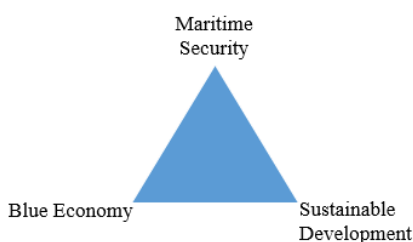
As far as maritime security is concerned, the nexus between maritime security and blue economy is explicit. By acting as an enabler of blue economy, maritime security is indispensable for protection of navigation routes, dispensing significant oceanic data to different ocean-related industries and concurrently protecting states’ resources alongside related maritime activities in their respective jurisdiction. Additionally, maritime security spurs economic growth and development given burgeoning blue economy necessitates development of maritime security capabilities that further catalyzes more investment of states in such capabilities. This signifies staunch nexus between blue economy, maritime security, and sustainable development which the author calls as ‘Blue Trinity’. It implies that blue economy leads to sustainable development whereby maritime security remains the key enabler.
Landscape of Blue Economy in IOR
The 21 century is characterized by pivot to Indian Ocean Region. (IOR). For centuries, the region has remained a center for global commerce and trade, and presently renamed as “Ocean of future” as well as “Ocean of Center”. Being bordered by more than 30 states and entailing expanse of almost 70 million square kilometers, it connects region of Middle East, Africa, coupled with South Asia, East Asia with Europe and beyond. Various economic sectors such as tourism, energy generation, aqua-culture and fisheries, and shipping play a dominant role in IOR. Additionally, marine biotechnology, renewable energy are emerging sectors in the region. Indian Ocean also entails key chokepoints such as Bab-el-Mandeb, Strait of Hormuz, Strait of Malacca and largest shipping lines of world that are indispensable for maritime oil trade. 8Additionally, the rich biodiversity of region coupled with critical mineral resources and enormous potential of renewable energy increase its importance for sustainable economic growth. However, the region faces challenges of marine pollution and misuse and abuse of marine resources that in turn are further exacerbated by climate change. In this regard, notion of blue economy holds vital importance for extracting resources, taping ocean’s potential, while simultaneously conserving marine environment.
Indian Ocean Naval Symposium primarily conceived by India in 2008 is regarded as voluntary initiative aimed at enhancing maritime cooperation among key Indian Ocean’s littoral states. The 24 member states of IONS present in four sub-regions possess enormous potential with respect to blue economy.9 States like Seychelles, Mauritius, Indonesia, as well as Bangladesh are trying to build sustainable blue economies. With the colossal potential ocean provides for economic growth and sustainability, it is essential to analyze emanating challenges and opportunities for IONS member states.
Challenges of Blue Economy for IONS States
1. Environmental Challenges
One of the key environmental challenges to the blue economy in Indian Ocean is climate change due to ever-enhancing emission of greenhouse gases in atmosphere that changes the structure, chemistry, and most notably temperature of ocean. This detrimentally impacts the marine ecosystem and coastal population primarily dependent on oceans. In terms of Indian Ocean, it is highly susceptible to climatic variations such as rise in sea-level, increasing sea-surface temperature, de-oxygenation and ocean acidification, as well as extreme-weather events. The impact of climate change-related threats will be more explicit in coming decades; however, immediate threats are beginning to surface.
As stated in the 2022 UN Ocean Conference in Portugal, oceans absorb nearly 90% of heat trapped in atmosphere; however, this phenomenon disrupts ocean health by causing ocean deoxygenation and acidification through dissolution of Carbon dioxide in oceans and forming carbonic acid. The increased acidity due to altered oceanic chemistry and decreased oxygen level disrupts the composition, diversification, and distribution of marine life. Additionally, increase in sea-level owing to 0.7% increase in surface temperature of sea coupled with glacial retreat has emerged as a key challenge. With respect to tropical Indian Ocean, during 1952-2015, the estimate average increase in temperature of sea-surface is 1 °C. One of the relevant examples is impact of climate change on fisheries in Indian Ocean Region as it will increase fish catch distribution in East Africa and will lead to 30-50% decrease in catch potential in Persian Gulf and Red Sea. By 2050, climate change is expected to decrease 30 % fish catch in Indonesian waters whereas 50% in Bay of Bengal. Furthermore, rising sea levels horrendously impact the fish habitat, coral reefs, and mangroves.
The menace of chemical, oil, and plastic pollution detrimentally implicates the Indian Ocean. Chemical pollution caused due to dumping of sewerage, pesticides, pharmaceutical chemicals, and fertilizers is prevalent because of ever-enhancing urbanization and lack of regulatory measures. Most importantly, chemical pollution causes algal bloom ─ a phytoplankton feeding on chemical pollutants ─ which in turn creates dead zones in ocean by impeding sunlight to reach ocean floor. One such example of dead zone is in Bay of Bengal. Moreover, algal bloom in IOR inflicted loss of $ 100 million per annum in last 25 years. In term of oil pollution, almost 40% of offshore oil production of world is carried out in IOR with Persian Gulf being the epicenter. Related to this is a hazard of oil spills, evident from 2020 Japanese oil vessel (MV Wakashio) disaster near Mauritius’ southern coast when it collided with coral reef, affecting 1,700 marine species, and subsequent washing ashore dolphins as well as whales, and destroying livelihood. Plastic pollution is one of lethal threats to marine environment in IOR as world’s largest contributors to plastic pollution are Indian Ocean littoral states such as Bangladesh, India, Thailand, Indonesia, and Malaysia. Additionally, river Indus and Ganges are most polluted rivers of worlds- flows into IOR. Indian Ocean is regarded as second most polluted ocean in world as almost 15 million tons of plastic waste flows into Indian Ocean on annual basis.
Illegal, Unreported, and unregulated fishing (IUU) is one of the key threats contributing to unsustainable fisheries. As per the key studies, 16-34% catches in IOR are regarded as illegal and unreported. It is multifaceted problem as it increases coastal population’ vulnerability with respect to livelihood and also undermines food security. Additionally, it also challenges the notion of maritime governance as it’s connected to illegal trade and forced labor. Moreover, it undermines international and regional bodies on fisheries management and regimes on fishing. IUU is intrinsically linked to geo-political concerns as arrests related to IUU in contested areas infuriate political problems between states.
2. Governance and Policy Challenges
Governance and policy challenges have been periling the materialization of blue economy in IONS member states. The four key challenges observed in this regard are:
- Lack of political momentum with respect to blue economy targets, and either absence or cornered presence of blue economy in integrated policy frameworks of states that in turn is quintessential for sustainable development.
- Ambiguous and inconsistent mandates pertinent to blue economy processes as well as structures for carrying out communication and coordination at governmental level. In addition, miniscule efficiency-cum-capacity of public sector for realization of agendas related to blue economy across different sectors (government and private) is pertinent problem.
- Limitations in government tracking mechanisms that in turn are crucial for execution of blue economy’s agendas. Such mechanisms include financial flow across different stakeholders.
- Feeble options for participation of government and non-government stakeholders in decision-making coupled with uniform policy information obstructing vision and commitments of states related to blue economy.
Governance framework challenges can be understood while analyzing issues at national, regional and international level. Many states in Indian Ocean have formulated laws and policies regarding species’ sustainable management, mitigating impact of climate change, and marine and land environment conservation; however, there is notable difference in implementation of these frameworks. Example can be cited of South Africa which has enacted multitudinous laws such as 2005 Biodiversity Act, 2008 Coastal management Act, 1998 Marine Living Resources Act but issues lie in limited concrete actions essential for curbing issues of climate change or food security through marine resources. Similarly, weak governance framework in Mozambique has caused exploitation of natural environment despite persistence of various laws and 2007 National Adaptation Program of Action that is primarily resilience to climate change and sustainable-cumintegrated management of oceans.
At regional level, disjointed regional efforts coupled with dearth of coherent policy and law framework have been a colossal hurdle in region-based approach towards blue economy. Regional coherence is tangential despite formulation of various forums such as 2016-2020 Regional Climate Action Plan and ACCNNR – African Convention on Conservation of Nature and Natural Resources. In terms of international framework, states in IOR have ratified various ocean related frameworks such as UNCLOS-United Nations Conventions on Law of Seas, CBD-Conventional on Biological Diversity, UNFCC- United Nations Framework Convention on Climate Change, Agreement on the Conservation and Management of Straddling Fish Stocks and Highly Migratory Fish Stocks, and even UNEP Regional Seas Program. Most notable is South Asian Seas Program which emphasizes addressing climate change, environmental issues, and Integrated Coastal Zone Management. The key issue in all these frameworks is dearth of specific guidelines to achieve various states goals and lack of operationalization of related laws and programs in true essence.
3. Economic and Technical Challenges
As per the expert estimation, Indian Oceans’ blue economy potential amounts to $25 trillion; however, due to lack of R& D (Research and Development) on marine resources exacerbated by the meagre investment in this sector, its humongous potential remains untapped evident from statistics that Indian Ocean littoral states harness marine resource worth $2.5 trillion. An example can be cited of Bangladesh whereby there is minimal investment of private sector in shipping despite the fact that shipping is responsible for 95% of international trade of Bangladesh, equivalent to $80 billion involving more than 3000 ships but Bangladesh possesses only 46 ships. Even it lacks required big fishing trawlers and the present trawlers have capacity of 80km.
Another example can be taken of Pakistan whereby 100 % of oil supplies and more than 90% of trade of country is sea-based, leading to tune about of nearly $74 billion. Despite having enormous potential in various sectors of blue economy such as fisheries, shipping, there is no dedicated investment mechanism. Moreover, lack of investment, except for limited investment in sectors like fisheries and shipping further exacerbates the situation. Various issues that plague the blue economy sectors includes challenges of capacity building, notably lack of deep-sea fishing fleet, and old means of fisheries’ harvest as well as catching. Human resource in country isn’t adequately skilled that is essential for harnessing blue potential of country. The country also doesn’t have modern equipment for tapping sea-bed resources leading to reliance on outside technical assistance. In the past, ship-breaking was used as mammoth source of revenue, but this sector is now facing investment challenges due to use of old methods, and absence of compliance of international rules, notably the Hong Kong Convention.18 With respect to shipping, there is one flag carrier company named Pakistan National Shipping Corporation (PNSC) with limited number of vessels having inadequate capacity to carry cargo, therefore leading to annual freight bills of $4-5 billion, as per UNCTA- United Nations Convention on Trade and Development. Similarly with respect to Gwadar port, presently, it can handle containers and general cargo vessels of up to 50,000 dwt; however, it is presently equipped with only three operational berths which is actually 1.5% of its total potential of 150 berths and 400 million tons of cargo handling capacity.
4. Security Challenges
The security environment of Indian Ocean signifies that notion of geo-politics undermines the prospects of materialization of geo-economic paradigm that is quintessential for maritime security and blue economy. First there is enhanced militarization of Indian Ocean marked by various military centric agreements such as LEMOA, COMCASA, and BECA; coupled with emergence of alliances like Quad and AUKUS. The Indo-US strategic convergence marked by Sino-Indian rivalry has intensified the geo-political rivalry leading to security-centric maritime approach of states. The situation is further aggravated by the wave of nuclearization further undermining the maritime security in region.
In addition, the recent upsurge in nontraditional security threats emanating from the Houthis attacks in Red sea in the back-drop of Israel-Gaza War have detrimentally impacted the maritime security in region. The red sea crisis has colossal repercussions for the shipping sector. As per the estimates, the total number of reported incidents since November 2023 are 133, entailing hijacking of 18 vessels by Somali Pirates and missiles attack on 14 vessels. Moreover, the threat to 20 submarine cables remains prevalent. The crisis in red sea has shifted shipping route around Cape of Good Hope which has led to increase in 6,000 nautical miles (increase of 14 days travel time) which has led to increase in freight rates and cost of goods.
Opportunities of Blue Economy for IONS Member States
1. Economic Growth
Indian Ocean possess enormous potential to catalyze economic growth and dispense sustainable livelihood for people in Indian Ocean littoral states. It is pertinent to analyze various blue economy sectors in order to comprehend how each sector can be boon for the nations in region.
- Coastal tourism: As per the 2016 statistics, nearly 1.2 billion visited the region for tourism and this figure is expected to increase to 1.4 billion by 2030. Various states in region earn almost US $1 billion on annual basis. This figure is high for Small Island States whereby states such as Mauritius and Seychelles earn more than 10% of GDP through tourism.
- Fisheries and aquaculture: In Indian Ocean, fisheries sector is key source of livelihood and foods. Fish is extracted in colossal quantity for export purpose and domestic consumption. Such fish include sea cucumbers, bonito, mackerel, and tuna. In future years, burgeoning population will increase this demand. With respect to aquaculture, it’s on increasing side due to its positive impact on biodiversity. Various dedicated projects of aquaculture in WIO-Western Indian Ocean related to finfish, seaweed, oyster, and shrimp are huge source of income and simultaneously food security.
- Mineral and oil: Indian Ocean’s oceanic crust is home to various deep-sea minerals such as manganese, cooper, cobalt and nickel, increasing prospects of deep-sea mining. Potential sea-bed mining locations identified are Central Indian Basin and Carlsberg Ridge. In terms of oil, the region is home to 40% ocean-based oil production. Many states in region have found potential reserves whereas some are exploring sites.
- Shipping: Being hub of one of key shipping lanes in worlds, Indian Ocean provides route to 100000 ships to transit on annual basis and almost 35 million barrels of oil passes though it on daily basis. With the increased demand in global trade, transportation of cargo through region is expected to increase, making it key sector of blue economy in future as well.
Case of Pakistan: Aforementioned sectors are illustrative of enormous blue economy potential in Indian Ocean which is expected to rise in future providing livelihood to people. But potential in these sector remains untapped, making it a latent source of economic growth and employment opportunities. A country-specific example of Pakistan would help in understanding the exact potential of each sector vital for economic growth. With respect to coastal tourism, Pakistan has estimated potential of $ 4.5 billion whereas there is meagre utilization of $0.05 million, oil and gas potential is $14 billion but utilization remains nil; and, minerals has estimated potential of $4-5 billion but actual utilization remains nil. Fisheries has estimated potential of $3 billion but utilization is $400-500 million alongside 1.8 million jobs. As far as export of seafood is concerned, potential is $2 billion while utilization is $450 million. Pakistan has huge $3 billion ship-breaking potential but utilization is only $100 million. There is lack of data on shipbuilding, offshore and coastal development, and renewable energy. In total all those sectors are expected to provide 5 million jobs but actual utilization is 1.8 million jobs.
2. Technological Innovation
Sustainable blue economy brings about plethora of technological opportunities for IONS member states. As clean technologies are pre-requisite for harnessing blue economy sectors, it leads to technological sophistication while ensuring health and sustainability of eco-system. The nexus of science-technology-innovation brings about paradigm shift from scarcity to abundancebased society. Technology is essential to explore avenues of growth’s source whereas innovation is essential for harnessing those resources for sustainable development. Technology is essential for ocean observation, scientific missions, as well as to increase productivity and efficiency for various sectors and reduce the cost of various sectors such as tourism, energy, shipping, and port facilities.
The key technologies that are essential for blue economy includes satellite technology, subsea engineering, nano-technology, biotechnology, imaging and physical sensors, big data analytics, as well as advanced Information and Communication technology. Additionally, other states that are utilizing emerging technologies such as Big data analytics and Block chain technology in managing their maritime supply chains alongside port facilities, enormously help them in dispensing services for shipping companies, stakeholders involved in marine transport, coupled with port operators. One of the most crucial area is technological advancement with respect to biotechnology whereby marine species are extracted and then later are used in various fields such as genetically modified fish, bio-materials, and nano-technology for producing economic dividends. Additionally, various compounds in oceans can be used for producing health-care products and nutraceuticals. Moreover, technological sophistication is essential for developing anti-fouling applications with respect to shipping industry and to reduce ocean pollutants. Last but the least, technological innovation is indispensable for tapping tidal and wind energy in addition to salinity gradient energy.
3. Environmental Sustainability & Regional Cooperation
Anthropogenic activities and exploitation of marine resources has horrendously impacted the marine ecosystem. Resorting to blue economy keeps the planetary boundaries intact and provides opportunity for use and management of ocean resources leading to eco-system preservation and regeneration. Additionally, it decreases pressure on ocean ecological services, thereby enhancing climate resilience.26 Examples can be taken of various sectors whereby tourism centered on biodiversity conservation protects marine environment, sustainable aqua-culture and fisheries curbs exploitation of fish resources. Additionally, clean marine energy initiatives can prove instrumental in decreasing carbon footprint.
4. Regional Cooperation
Blue economy has immense potential to foster regional cooperation and knowledge sharing amongst various member states of IONS. Given the similarity in challenges IONS member states with regards to maritime environment, exploitation of blue economy through collaborative can buttress cooperation in various areas. For example, maritime security can be the priority areas given mutual threat of illegal fishing, smuggling, terrorism etc. Various initiatives falling under the collective and maritime domain awareness such as capacity-building initiatives, information sharing networks, as well as joint patrols can bring about maritime security. Moreover, states can also cooperate on Marine resources management especially with respect to minerals and fisheries through joint monitoring, regulation mechanism, and R & D projects. Another key collaboration area can be environmental protection notably climate change and marine pollution through regional conservation of marine resources, disaster management, and technology transfer. Lastly, connectivity gaps and inadequate facilities and infrastructure can be curbed through investment in different connectivity projects and port infrastructure.
Way Forward for Sustainable Development
- Improving Governance:In order to harness the blue economy potential and curb existing lacunas at policy and governance level; two-level approach is required. At regional level, within Indian Ocean Naval Symposium, a working group or a forum can be created for the formulation of concrete policy as well as regulation framework with respect to blue economy initiatives. Additionally, in order to buttress mutual trust and enhance cooperation, blue economy governance related dialogues alongside capacity-building workshops may be organized twice in years. At national level, the formation of integrated maritime policies in line with the national economic and development policies with clear stated goals alongside ends, ways, and means to achieve them will bring effective results.
- Sustainable Financing: For diminishing the challenge of economic resources, states must prioritize the public-private partnership whereby government must ensure to formulate private sector friendly policies alongside adequate conducive environment for investment and essential data sharing with concerned sector is significant. Additionally, states can follow sustainable financing and blue bonds which are beneficial for diverting investment towards sustainable ocean-related projects, for instance, renewable energy initiatives, fisheries management, coastal resilience projects, as well as marine conservation projects. For the purpose of garnering capital from investors, organization and governments can issue blue bonds that on one hand reduce interest rate while on other hand increase the repayment period, therefore supporting the economically feasible blue initiatives. The model of Seychelles is pertinent in this regard when in 2018 it initiated ‘Seychelles Blue Bond’ to improve fisheries governance and increase its maritime protected areas. Blue Investment Fund and Blue Grant Fund under the Development Bank of Seychelles and SeyCCAT-Seychelles Conservation and Climate Adaptation Trust process the loans and grants.
- Research and Innovation: Technology transfer and innovation is quintessential for overcoming technology challenges with respect to blue economy. For that purpose, IONS can formulate ‘Technology Transfer Framework’ for buttressing technology transfer among member states. Holistic guidelines, procedures alongside incentives shall be documented in that framework, leading to concrete pathways for accessing required technology to tap blue potential. States can kick- off joint research projects either bilaterally or through forum of IONS. IONS can also create knowledge-sharing platform that in turn can act as centralized hub for technical specification, practices and information sharing. Additionally, capacity building training programs at national and regional level (within IONS) can be instrumental in skill development and knowledge sharing. Furthermore, states shall formulate marine innovation and research hubs.
- Ameliorating Environment Challenges: In order to address the environmental challenges, stringent implementation of policy and regulatory framework is need of time to ensure sustainable practices and to concurrently ensure marine conservation, as well as promote sustainable projects like renewable energy. For curbing marine pollution, again a two-level approach is required. At regional level, marine pollution framework outlining agendas alongside proper monitoring mechanism. Moreover, waste disposal technology sharing may prove instrumental in this regard. At national level, states waste dispose facilities and frequent inspection drives are need of time. Few examples are pertinent in this regard. Kenya has employed different ocean-based mitigation and adaptation measures, entailing initiatives like Payment of Eco-system services as well as seaweed farming for safeguarding blue carbon eco-systems. Moreover, it has invested in climate-smart aquaculture, and fisheries to reduce detrimental impact of climate change and to safeguard small farmers, through insurance.
As far as Mozambique is concerned, its ‘Marine Spatial Plan’ is indispensable initiative of country grounded on scientific estimation of climate hazards and risk in order to facilitates adaptation and mitigation measures.28 In case of Vietnam, it has given importance to environmental consideration in its sea-port planning, protection of mangroves, sustainable aquaculture. Moreover, it supports climate resilience measures including information connectivity among storm shelters and boats; fishing boats, alongside formation of flood risk maps. Such initiatives can be a role model for other states. - Collaborative Maritime Security Mechanism: or ensuring maritime security in region, a concrete region-based approach is indispensable for curbing traditional and non-traditional security threats. With respect to geo-politics eroding the maritime security, IONS member states must foster dialogue bilaterally or through forum of ION that can be termed as ‘IONS Dialogue for Peace’. Moreover, IONS member states must increase Maritime Domain Awareness through forging relations, primarily through IONS platform. For the purpose of collaboration, it is crucial to identify ‘mutual areas’. This regional outlook to Maritime Domain Awareness requires formulation of shared structures, indispensable for maritime security. Maritime monitoring is one of key fundamentals MDA which in turn is grounded on harbor patrols, air and sea surveillance, and coastal radar. To coordinate information at regional level, organizational structure/body shall be formulated. Additionally, ‘IONS Regional Training Centre’ for MDA that can produce cadre of intelligence analysts is vital; moreover, for the purpose of information gathering regarding key threats requires institutional mechanism. The creation of regional mechanism and centers at one hand would permit information sharing with respect to key challenges while on the other hand provide avenues for Research and Development. It would enable Joint-threat response and operation mechanism.
Conclusion
Blue economy offers staunch prospects for economic growth and sustainable development for IONS states by acting as a holistic and eco-friendly approach to employ ocean resources. IONS member states can safeguard marine environment, further economic growth, and concurrently increase resilience against economic-cum-environmental shocks by adopting fundamentals of inclusivity and sustainability.
To thrive blue economy, IONS member states must overcome the perilous challenges by resorting to innovative solutions at national level and collaborating at regional level through forum of IONS In order to navigate the complexities prevailing the various sectors of blue economy, steadfast commitment to formulation and materialization of targets and adherence to policy frameworks while addressing governance lacunas are indispensable. Moreover, sustainable financing, research and innovation, and adopting climate-smart and eco-friendly practices would prove instrumental in harnessing actual potential pertinent to blue economy. Through prioritization of sustainability goal, and enabling secure maritime environment, nations of IONS can capitalize on maritime strengths to create a prosperous future grounded on equilibrium between environmental stewardship and economic growth.
Bibliography
- Anagha P. "Impact of Climate Change on the Blue Economy of the Indian Ocean Region: Case Study of the Fisheries Sector." Vivekananda International Foundation- Seeking Harmony in Diversity. September 9, 2022. https://www.vifindia.org/article/2022/september/09/impact-of-climate-change-on-theblue-economy-of-the-indian-ocean-region
- Aparna Roy. "Blue economy in the Indian Ocean: Governance perspectives for sustainable development in the region." ORF Occasional Paper 181 (2019). https://www.orfonline.org/research/blue-economy-in-the-indian-ocean-governanceperspectives-for-sustainable-development-in-the-region
- Ashish Chaturvedi. "Pursuing a Blue Economy for a Sustainable and Resilient Future." UNDP. Accessed June 24, 2024. https://www.undp.org/india/blog/pursuing-blue-economysustainable-and-resilient-future
- Australian National University. Combatting IUU fishing in the Indian Ocean. (2024). National Security College. https://nsc.crawford.anu.edu.au/department-news/20982/combattingiuu-fishing-indian-ocean
- Benzaken, Dominique, Michelle Voyer, Angelique Pouponneau, and Quentin Hanich. "Good governance for sustainable blue economy in small islands: Lessons learned from the Seychelles experience." Frontiers in Political Science 4 (2022). doi:10.3389/fpos.2022.1040318.
- Common Wealth of Learning. The blue economy: Origin and Concept. Accessed June 24, 2024. https://www.col.org/news/the-blue-economy-origin-and-concept/
- Darshana M. Baruah, Nitya Labh, and Jessica Greely. Mapping the Indian Ocean region. June 15, 2023 Carnegie Endowment for International Peace. https://carnegieendowment.org/research/2023/06/mapping-the-indian-oceanregion?lang=en
- FOA. Faolex Data Base. Accessed 23 June, 2024. https://www.fao.org/faolex/results/details/en/c/LEX-FAOC185653/
- Francois Vreÿ, and Mark Blaine. "Red Sea and Western Indian Ocean Attacks Expose Africa’s Maritime Vulnerability – Africa Center for Strategic Studies." Africa Center for Strategic Studies. Last modified April 10, 2024. https://africacenter.org/spotlight/red-sea-indianocean-attacks-africa-maritime-vulnerability/.
- Hargun Kaur. "Marine Pollution in the Indian Ocean: An Alarming Bell." CeSCube. 10 January, 2022. https://www.cescube.com/vp-marine-pollution-in-the-indian-ocean-an-alarmingbell.
- Indian Ocean Naval Symposium. “About IONS”. Accessed 23 June, 2024. https://www.ions.global/.
- Malshini Senaratne, and Andrew Zimbroff. "The Blue Economy in the Indian Ocean–A Literature." https://seychellesresearchjournal.com/wp-content/uploads/2019/08/the-blueeconomy-in-the-indian-ocean-a-literature-review-malshini-senaratne-andrewzimbroff.pdf.
- Michelle Voyer, Clive Schofield, Kamal Azmi, Robin Warner, Alistair McIlgorm, and Genevieve Quirk. "Maritime security and the Blue Economy: intersections and interdependencies in the Indian Ocean." Journal of the Indian Ocean Region 14, no. 1 (2018), 28-48. doi:10.1080/19480881.2018.1418155
- Nazir Hussain. "Pakistan’s Blue Economy Potential, Challenges and Prospects." Strategic Thought 4, no. 1 (2022): 1-12. file:///C:/Users/user/Downloads/01-pakistans-blueeconomy-dr.-nazir-hussain%20(4).pdf
- Pabasara Kannangara, Adam Collins and Barana Waidyatilake. "The Importance of the Indian Ocean: Trade, Security and Norms." The Lakshman Kadirgamar Institute. Last modified February 1, 2019. https://lki.lk/publication/the-importance-of-the-indian-ocean-tradesecurity-and-norms/
- Safia Mansoor, “Strategic Maritime Environment in Indian Ocean Region”. The Beacon Journal 2021-2022. https://pnwc.paknavy.gov.pk/thebeaconjournal/crs/Vol1No1_2021/9.%20STRATEGIC%20MARITIME%20ENVIRONMENT%20IN%20INDIAN.pdf
- Sibylle, Dueri. "Impacts of climate change and ocean acidification on Indian Ocean tunas." IDDRI, Report in" Impacts of climate change and ocean acidification on Indian Ocean tunas (2017). https://www.iddri.org/sites/default/files/PDF/Publications/Hors%20catalogue%20Iddri/tuna-climate%20change%20indian%20oceanEN.pdf
- Solutions for Youth. Blue economy: Structural transformation and Implications for Youth Employment. April 2023. https://www.s4ye.org/sites/default/files/2023-05/Blue%20Economy%20%20and%20Youth%20Employment%20Final%20v2.pdf
- The Daily Star. "Blue Economy Potential Largely Untapped: Experts.". Last modified September 6, 2019. https://www.thedailystar.net/city/news/blue-economy-potential-largelyuntapped-experts-1796272
- The energy and Resource Institute. Steering Ahead – Leveraging Science, Technology and Innovation in Blue Economy”. TERI Working Paper II – February 2021. https://www.teriin.org/sites/default/files/2021-05/wp2-STI-Blue-economy-India.pdf
- UN. "Mozambican Marine Spatial Planning for Coastal and Ocean Management. Accessed 20 June, 2024. https://sdgs.un.org/partnerships/mozambican-marine-spatial-planning-coastaland-ocean-management.
- UNDP. "Pursuing a Blue Economy for a Sustainable and Resilient Future." June 8, 2023. https://www.undp.org/india/blog/pursuing-blue-economy-sustainable-and-resilientfuture
- United Nations. “The 17 Goals.” The 17 goals. Accessed 23 June, 2024. https://sdgs.un.org/goals
- United Nations. Blue economy definitions.. Accessed June 24, 2024. https://www.un.org/regularprocess/sites/www.un.org.regularprocess/files/rok_part_2.pdf
- World Bank Group. "Seychelles Launches World’s First Sovereign Blue Bond.". Last modified October 29, 2018. https://www.worldbank.org/en/news/pressrelease/2018/10/29/seychelles-launches-worlds-first-sovereign-blue-bond
- Zofeen Ibrahim. Pakistan’s key CPEC port a long way from trade hub vision. Dialogue Earth. Last modified August 11, 2021. https://dialogue.earth/en/business/pakistan-gwadar-port-longway-from-trade-hub-vision/
