

BLUE ECONOMY: WAYS FORWARD FOR SUSTAINABLE DEVELOPMENT OF IONS MEMBER STATES
Cooperation on HADR: Providing Assistance, Protection, and Preservation of Maritime Environment in IOR
Submitted By — Forward Ever
Preface
The Indian Ocean Region (IOR) is entering a defining moment. As one of the world’s most critical maritime spaces—encompassing vast Exclusive Economic Zones (EEZs), busy sea lanes, and ecologically sensitive coastal zones—it plays a pivotal role in global trade, food security, and energy flows. Yet, alongside its promise lies an alarming vulnerability: the IOR is a disaster-prone theatre where rising sea levels, extreme weather events, and geopolitical tensions routinely test the resilience of its littoral states.
Within this setting, the concept of the Blue Economy—which aims to derive sustainable economic growth from ocean resources—has gained strategic traction. Simultaneously, the need for robust Humanitarian Assistance and Disaster Relief (HADR) frameworks has never been more urgent. This report posits a bold but necessary thesis: that the Blue Economy and HADR are not separate agendas, but intertwined imperatives that must be pursued in tandem to safeguard the IOR’s ecological, economic, and social futures.
Structured across three chapters, the essay begins by tracing the evolution of the Blue Economy and its intrinsic linkage with HADR operations. Chapter One introduces a five-pillar framework—Preparedness, Response, Recovery, Protection, and Preservation—that redefines HADR not just as an emergency response but as an enabler of long-term sustainability. Chapter Two dives into the operational landscape of IONS navies, analysing real-world disaster relief missions, identifying systemic gaps, and proposing a pathway to integrate national capabilities into a cohesive regional mechanism. Finally, Chapter Three offers a forward-looking strategy anchored in the 3Cs of Collaboration (Coordination, Capacity Building, Commitment) and the 3Rs of Resilience (Research, Restoration, Regulation)—a dual framework designed to future-proof the region’s collective disaster readiness and ecological stewardship.
To move from concept to action, the essay also outlines a phased roadmap from 2025 to 2035, proposing pragmatic initiatives including regional training hubs, mini-satellite constellations, pre-approved Status of Forces Agreements (SOFAs), and a Blue Economy Innovation Fund. The vision is to equip IONS not just as a dialogue platform, but as a strategic institution capable of transforming maritime vulnerabilities into opportunities for inclusive growth and resilience.
Chapter 1 — Blue Economy and HADR: A Symbiotic Relationship
Introduction
1. Blue Economy Origins and Evolution. The idea of a Blue Economy crystallised as the global conversation on sustainable development gathered pace in the late twentieth century. The 1987 Brundtland Report first framed oceans as a planetary “balance of life”, warning that pollution, over-extraction and unregulated shipping threatened that balance . Seven years later, Belgian economist Gunter Pauli coined the term "Blue Economy", championing business models that create wealth and jobs while actively regenerating marine ecosystems . His vision became mainstream when, in 2015, the United Nations adopted the 17 Sustainable Development Goals—anchoring ocean stewardship in SDG 14 “Life Below Water”. Yet recent UN progress charts reveal that targets such as curbing ocean acidification, ending Illegal, Unreported and Unregulated (IUU) fishing and restoring coastal habitats are stalling, underscoring the need for new momentum and partnerships.
2. Relevance for IONS. The Indian Ocean Region (IOR) is both opportunity-laden and disaster-prone. Twenty-five IONS member states depend on their surrounding waters for food security, tourism and maritime trade. A 2024 analysis reveals that 15 IONS members have over 50% of their sovereign territory underwater, with nations like Maldives and Seychelles nearing 100% . At the same time, the IOR is a hotspot for tsunamis, cyclones and coastal flooding. Catastrophic events such as the 2004 tsunami demonstrated how swiftly decades of economic gains can be erased when littoral communities lack robust Humanitarian Assistance and Disaster Relief (HADR) frameworks. The sustainability of the Blue Economy and the effectiveness of HADR are therefore not parallel agendas—they are mutually reinforcing imperatives.
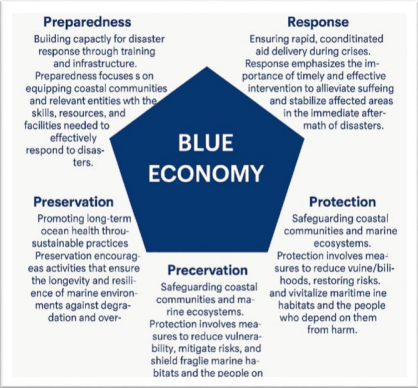
3. Bridging the Divide: From Necessity to Strategy. Given the unique maritime vulnerabilities and economic dependencies of IONS nations, there is an urgent need to integrate disaster resilience into the core of Blue Economy planning. This integration must move beyond reactive response and embrace a holistic, structured approach to disaster risk governance. This essay proposes a forward-looking preamble centred on five foundational pillars that fuse Blue Economy development with HADR cooperation which is as appended below:-
| Ser | Pillar | Focus | Key Actions | Desired Outcome for IONS States |
|---|---|---|---|---|
| (a) | Preparedness | Capacity-building & risk awareness | Early-warning systems, joint training, resilient infrastructure | Proactive posture with swift mobilisation and minimal loss |
| (b) | Response | Rapid, coordinated relief | Naval & airlift assets, field hospitals, agile logistics | Seamless, multilateral crisis response with minimal economic impact |
| (c) | Recovery | Build-back-better reconstruction | Rehabilitate infrastructure, restore livelihoods & ecosystems | Fast economic rebound and enhanced resilience |
| (d) | Protection | Ongoing risk reduction | Maritime surveillance, disaster risk reduction, pollution control | Stronger coastal defence against recurring threats |
| (e) | Preservation | Long-term ocean health | Conservation, pollution control, climate resilience initiatives | Sustained marine wealth for future Blue Economy growth |
These pillars aim to integrate HADR into the Blue Economy, ensuring sustainable development without compromising environmental integrity.
The Role of HADR
4. Defining HADR. HADR is a military cooperation that aims to save lives, reduce suffering, and resolve emergencies during natural disasters. HADR encompasses humanitarian assistance (e.g., food, medical aid) and disaster relief (e.g., search and rescue, infrastructure repair) in response to natural or man-made crises. In the IOR, HADR is critical due to the region's vulnerability to climate-driven disasters. The 2004 Indian Ocean Tsunami, which killed over 230,000 people across 14 countries, highlighted the need for coordinated HADR. Maritime forces, with their mobility and logistical capabilities, are uniquely positioned to lead HADR efforts.
5. HADR and Blue Economy Nexus. Humanitarian Assistance and Disaster Relief (HADR) and the Blue Economy are deeply interconnected, each reinforcing the other. A resilient HADR framework protects coastal infrastructure and livelihoods, while a thriving Blue Economy provides the resources to enhance disaster response capabilities. This symbiotic relationship unfolds across several key domains economic protection, community resilience, environmental preservation, and strategic investment as outlined below:-
(a) Protecting Economic Assets. A well-resourced HADR architecture speeds up the restoration of fisheries, coastal tourism, and maritime trade after cyclones, tsunamis, or oil-spill incidents. Swift damage assessments, pre-positioned relief stores, and rapid reopening of ports shorten downtime for critical supply chains. As a result, local livelihoods rebound sooner and national revenue losses are contained within manageable limits. This resilience attracts further private investment to the Blue Economy.
(b) Safeguarding Coastal Communities. Disaster-prepared coast guards, navies, and civil agencies reduce both casualties and the indirect economic shock borne by shoreline populations. Timely evacuations, medical outreach, and temporary shelters prevent displacement from becoming permanent migration. When families can return quickly to repaired homes and restored jobs, community cohesion is preserved and social safety-net costs fall. Strong community confidence, in turn, underpins sustainable coastal development.
(c) Preserving Marine and Littoral Ecosystems. HADR forces trained in environmental response limit secondary ecological damage, such as toxic runoff, coral-reef abrasion, or mangrove loss. Rapid containment of fuel leaks and debris removal accelerates ecological recovery, enabling fisheries and eco-tourism to resume sooner. Healthy ecosystems also act as natural buffers against future hazards, lowering the scale of subsequent HADR interventions. Thus, environmental stewardship and disaster preparedness reinforce each other.
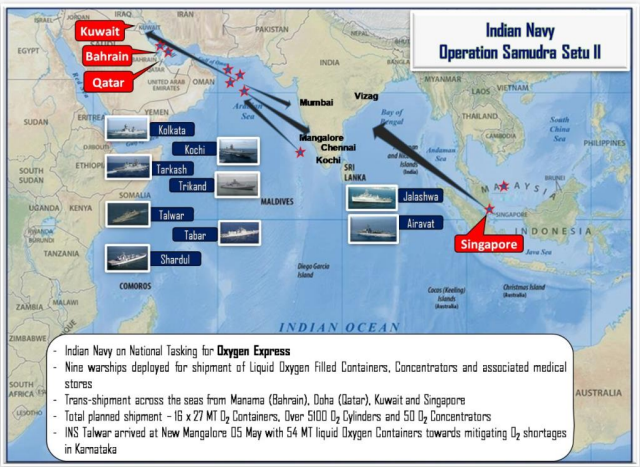
(d) Financing the Virtuous Cycle. A thriving Blue Economy generates the fiscal space to invest in better HADR platforms, surveillance networks, and specialised training. Revenues from sustainable maritime trade and coastal industries fund multipurpose vessels, drones, and data analytics that double as disaster-relief assets. India’s 2020–21 Operation Samudra Setu, which used naval amphibious ships to deliver medical aid across the Indian Ocean Region during the COVID-19 pandemic, illustrates how economic vitality and humanitarian outreach can reinforce one another . Details of Samudra Setu II are as illustrated below.
Chapter 2 — Elements of Resilience and Challenges to HADR in the IOR — An IONS Perspective
Introduction
1. Chapter 1 established the Blue Economy paradigm for Indian Ocean Naval Symposium (IONS) nations, introducing the five-pillar HADR preamble as the conceptual backbone for sustainable maritime growth. Building on this foundation, Chapter 2 pivots from “why” to “how”—examining the operational realities that shape the ability of IONS member navies to translate these principles into rapid, life-saving action at sea
2. The frequency and intensity of disasters in the Indian Ocean Region (IOR) have risen sharply in recent years, with 60% of global disasters now occurring within its waters and littorals. Catastrophic events such as the 2004 tsunami and Typhoon Haiyan underscore the region’s acute vulnerability. In the wake of such large-scale emergencies, rapid and sustained response becomes critical. This is where maritime forces, particularly naval task groups, play a pivotal role. With the ability to mobilise quickly, generate decisive mass within hours, and commence support operations almost immediately, they offer a level of responsiveness and endurance that is often beyond the reach of most land-based agencies.
3. This chapter aims to lay out a common operational philosophy for IONS nations, seeking to dovetail individual strengths into a credible, collective HADR capacity for the IOR—and, when called upon, beyond. By consolidating this base, IONS ensures that future disaster responses are as swift, integrated, and sustainable as the stakes demand.
4. The scope of this chapter is fourfold: first, it identifies the core Elements of Resilience that coordinated HADR activities can reinforce across the IONS community; second, it analyses persistent operational and strategic challenges that currently blunt effective action; third, it reviews a decade-long empirical record of intra-IONS HADR operations to extract lessons, trends, and best practices; and finally, it offers a pragmatic way forward—covering institutional reforms, material solutions, and technology adoption—to convert episodic goodwill into an agile, standing maritime safety net for the entire Indian Ocean Region.
Building Resilience through HADR
5. To operationalise an effective and sustainable HADR framework in the Indian Ocean Region (IOR), it is essential to identify the foundational building blocks of resilience that regional navies and institutions can reinforce through coordinated action. These Elements of Resilience are not isolated components but interdependent domains that collectively determine the speed, impact, and longevity of disaster relief outcomes. The subsequent sections examine three critical elements—Rapid Response, Community Protection, and Environmental Preservation—each offering a strategic function in enhancing the IONS nations’ capacity to prepare for, absorb, and recover from maritime disasters.
Rapid Response
6. The Indian Ocean Region (IOR) is one of the most disaster-prone maritime zones globally, with over 60% of natural disasters occurring within or near IONS nations. In such a context, timeliness in the deployment of naval assets during the golden 72-hour window becomes the primary determinant of HADR effectiveness Navies possess the agility, endurance, and mass to arrive early and deliver critical life-saving aid.
However, the efficiency of response operations is not just about capability—it hinges on how well naval units integrate into broader relief frameworks. Civil-military synergy is essential. As HADR becomes increasingly multilateral, foreign navies must be willing to coordinate under the civilian leadership of the affected nation.
7. The absorptive capacity of the disaster-struck country—the ability of its local institutions to receive, coordinate, and utilise foreign assistance—also defines the success of naval deployments. Therefore, IONS members must strive for self-reliant HADR modules that reduce the logistical burden on vulnerable states.
Community Protection
8. Community resilience requires more than rescue—it needs appropriateness in both assistance and conduct. Naval forces must remain culturally sensitive while operating in foreign territories, ensuring their aid respects local customs and traditions. Moreover, forces should demobilise promptly once their mission concludes to avoid overstaying or undermining local authority. Coordination remains a key challenge. Humanitarian NGOs, civil defence agencies, and military units often differ in operating cultures, timelines, and protocols. IONS must continue to invest in pre-disaster coordination mechanisms—joint SOPs, liaisons, and civil-military exercises to align these actors14 .When implemented well, such coordination has demonstrably enhanced evacuation, shelter, and medical efforts across IONS-led operations.
Environmental Preservation
9. The protection and rehabilitation of marine ecosystems is central to sustainable recovery. Here, cost plays a significant role. While military-led clean-up operations and pollution control (e.g., oil-spill response, coral reef rehabilitation) are generally expensive, the IONS HADR Guidelines clearly state that such assistance must be offered at no cost to the affected nation unless otherwise agreed upon This principle reinforces solidarity while ensuring the rapid deployment of high-capability assets without diplomatic delay. Environmental resilience also benefits from appropriately self-contained units—ships and aircraft that bring their own fuel, power, medical kits, and crew support Such autonomy ensures operations are not bottlenecked by the limited environmental or logistical resources in fragile coastal zones.
Recent HADR Operations Among IONS Member States (2015–2025)
10. To understand the operational dynamics and inter-navy cooperation within the Indian Ocean Region (IOR), it is instructive to examine actual Humanitarian Assistance and Disaster Relief (HADR) missions undertaken by IONS members over the last decade. These events provide not only a snapshot of IONS’ current capacity but also highlight areas where improvement is both necessary and achievable. The table appended below collates notable events between 2015 and 2023 that involved IONS member states. Six were real-world disasters, one was a ministerial working-group session that drafted HADR guidelines, and one was the large-scale exercise IMEX 22, included here because it was the sole occasion on which a majority of IONS navies attempted a full-spectrum relief rehearsal under simulated conditions. By placing real crises and the one major exercise side by side, the table reveals how far the region has progressed—and how far it has yet to go toward a genuinely integrated, standing response mechanism.
| Disaster / Location | Year | Affected State(s) | Assisting IONS Navies | Nature of Assistance | IONS Combined Action? | Key Gap / Reason |
|---|---|---|---|---|---|---|
| Cyclone Pam (Vanuatu) | 2015 | Vanuatu | Australia | Air-sea lift, engineering | Partial – ad hoc bilateral | No formal IONS trigger mechanism |
| Sulawesi Tsunami | 2018 | Indonesia | India, Singapore | MEDEVAC, SAR | No | Entry delayed by sovereignty constraints |
| Working Group Meeting | 2018 | Indian Ocean — Eight Countries | — | Discussion on HADR | — | Draft HADR Guidelines formulated |
| Cyclone Idai | 2019 | Mozambique | South Africa, India | SAR, relief stores | No | East African sub-region lacked an IONS liaison cell |
| MV Wakashio Oil Spill | 2020 | Mauritius | India, France (observer) | Pollution response, containment | Yes – pilot pollution SOP | Limited specialist gear for SIDS |
| Cyclone Tauktae | 2021 | India | — (self-reliant) | National naval SAR | No | Capability asymmetry; assistance not requested |
| IMEX 22 (Exercise) | 2022 | Simulated | 16 IONS navies | Full-spectrum HADR drill | Yes | Exercise only |
| Cyclone Freddy | 2023 | Mozambique, Madagascar | South Africa, India, France | Relief, SAR | No | Limited MDA |
11. Challenges to HADRViewed through this operational lens, the six enduring hurdles that constrain IONS become unmistakably clear. Coordination gaps persist because the Maritime Disaster Coordination Cell (MDCC) remains unratified. Resource asymmetry leaves Small Island Developing States (SIDS) and Least Developed Countries (LDC) dependent on external assets. Climate-driven disasters are intensifying faster than preparedness measures are implemented. Information sharing is fragmented, hampering a common operating picture. Infrastructure deficits—especially damaged or shallow ports— impede last-mile aid. Finally, sovereignty sensitivities continue to delay or restrict foreign naval access during the critical early hours of a crisis. Each of these shortcomings is illustrated by at least one case in the table above, underscoring that they are not abstract policy issues but lived operational realities. A Brief description is explained in subsequent paragraphs.
12. Coordination Gaps. The IOR’s diverse political systems and overlapping subregional bodies create fragmented command chains. While IONS has proposed a standing Maritime Disaster Coordination Cell (MDCC), consensus on issues such as lead nation rotation has delayed its ratification. This lack of a unified mechanism often results in ad-hoc or delayed responses during crises
13. Resource Constraints. Small Island Developing States (SIDS) and Least Developed Countries (LDCs) field few blue-water hulls and have limited logistics. A proposed common "HADR Equipment Pool" remains unfunded, as larger navies balance Indo-Pacific commitments with home priorities. This resource asymmetry leaves many states reliant on external support.
14. Climate-Driven Disasters. Rising sea surface temperatures are fuelling more frequent and intense Category 5 cyclones, which can rapidly outstrip national stockpiles. Although IONS endorsed a Climate Risk Road Map in 2024, implementation has lagged amid sensitivities over data sharing and national preparedness gaps.
15. Information Sharing. Real-time Maritime Domain Awareness (MDA) is uneven; only 18 members feed data to the IFC-IOR 24/7. Others cite bandwidth costs and cyber security concerns, impeding the creation of a common operating picture during crises. This hampers situational awareness and hinders coordinated action.
16. Infrastructure Deficits. Damaged ports, shallow drafts, and limited warehousing slow the offloading and distribution of aid. An IONS-led audit in 2023 identified 31 critical "last mile" gaps, but donor uptake and infrastructure investment have been modest, leaving many vulnerable points unaddressed.
17. Sovereignty Concerns. Several states prefer civilian-led aid to preserve domestic optics and political autonomy. As a result, military platforms often loiter offshore awaiting diplomatic clearance, as seen after the 2018 Sulawesi tsunami. These sovereignty sensitivities can delay or limit the effectiveness of multinational HADR efforts.
Way Forward
To transform episodic goodwill into an agile, standing maritime safety net, IONS must:
- Institutionalise Coordination. The Maritime Disaster Coordination Cell (MDCC) must be formalised and ratified by all member states. A harmonised SOP for its activation and leadership rotation is critical.
- Invest in Capacity Building. A proportionally funded regional HADR Equipment Pool should be established to support capability-challenged nations with vital gear such as pollution-control kits, water purification units, and field hospitals.
- Leverage Technology. Member nations must enhance real-time connectivity with IFC-IOR and strengthen cyber-secure MDA platforms to enable rapid threat recognition and shared situational awareness.
- Promote Inclusive Planning. Inclusivity must be embedded in planning and execution. Small and vulnerable nations should have a clear voice in mission design and should equally benefit from capacity-building initiatives and shared assets.
- Respect Sovereignty. Finally, to address sovereignty concerns without compromising response timelines, IONS members should work toward finalising preapproved Status of Forces Agreements (SOFAs) for disaster scenarios. These agreements would allow foreign naval platforms to enter affected zones under civilian oversight with minimum bureaucratic delay.
19. By addressing these challenges head-on, IONS can consolidate its role as the region’s premier HADR coordinator, ensuring that the collective response to future disasters is as swift, integrated, and sustainable as the stakes demand.
Chapter 3 — Forging a Resilient Future: Way Ahead for IONS
— UN Secretary-General António Guterres
Strategic Imperative for Integration
1. The preceding chapters have outlined the symbiotic relationship between the Blue Economy and HADR and assessed the resilience gaps and operational realities shaping HADR delivery across IONS nations. Chapter 3 now looks ahead—framing a strategic roadmap for the Indian Ocean Naval Symposium (IONS) to evolve from a consultative forum into an institutionalised enabler of sustainable maritime growth and disaster preparedness. The central thesis: HADR is not merely a contingency tool but a transformative pillar of maritime governance in the IOR.
2. The Indian Ocean Region (IOR), home to over 2.7 billion people, is poised at a crossroads. Its vast marine resources can catalyse inclusive development—but only if they are stewarded through coordinated action, resilient infrastructure, and shared responsibility. For IONS to play a central role, it must lead with a forward-looking vision grounded in capacity, connectivity, and credibility.
3. 3Cs of Collaboration — Foundations of Maritime SolidarityTo operationalise this vision, IONS must strengthen its cooperative architecture. This begins with the adoption of a practical and actionable framework based on the 3Cs of Collaboration—Coordination, Capacity Building, and Commitment. These pillars are not abstract ideals but essential enablers that can unify diverse capabilities into a credible, sustained maritime safety net for the entire IOR.
Coordination – Institutional Mechanisms and Real-Time Response
4. A permanent IONS HADR Command Centre—hosted in a neutral maritime state such as Seychelles or Oman—can serve as the nucleus for real-time monitoring, rapid decision making, and logistical command. This command centre should integrate data feeds from the Information Fusion Centre – Indian Ocean Region (IFC-IOR), regional Coast Guard inputs, and satellite telemetry to generate a shared operational picture during crises.
5. To enhance responsiveness, this node must work on pre-approved Standard Operating Procedures (SOPs) with built-in civilian oversight, ensuring that sovereignty concerns are respected without slowing down deployment. The success of Combined Task Forces (CTFs) in anti-piracy operations in the Gulf of Aden offers a template
Capacity Building – Empowering the Vulnerable
6. To bridge capability gaps, larger IONS navies such as India, Indonesia, and France must commit to a Technology and Training Transfer Protocol (TTTP). This protocol can formalise the provision of disaster-response vessels, UAVs, pollution control kits, and field medical units to Small Island Developing States (SIDS) and Least Developed Countries (LDCs).
7. Regional HADR Training Hubs, co-hosted by Australia and India, could offer specialised courses for navy and coast guard personnel in search and rescue (SAR), oil spill containment, underwater recovery, and cultural sensitivity training—ensuring that every participating nation can field at least a basic HADR response unit.
Commitment — Building Maritime Trust
8. Regular multilateral HADR exercises—beyond IMEX—should be institutionalised under the IONS Resilience Exercise Series (IRES). These exercises must go beyond token simulations and replicate real-world disaster scenarios involving simultaneous deployment across critical sectors such as logistics, environmental rehabilitation, port restoration, and civil coordination. This immersive, multi-agency approach will not only strengthen interoperability but also instil confidence in the region’s collective readiness.
9. Complementing these drills, the publication of an Annual IONS Blue Economy and Resilience Report will foster transparency and accountability. This report can serve as a benchmarking tool to assess progress on capacity building, highlight best practices, and track national contributions. Over time, it can create a culture of measurable commitment, peer learning, and informed resource allocation.
The 3Rs of Resilience – Sustaining Progress
10. While coordinated response mechanisms ensure timely relief, the true strength of the Blue Economy lies in the region’s ability to anticipate, absorb, and adapt to maritime disruptions over time. Building this enduring resilience requires IONS to embrace the 3Rs of Resilience: Research, Restoration, and Regulation. These three domains—scientific, ecological, and legal—form the long-term scaffolding of sustainable maritime governance and disaster preparedness.
Research — Climate and Oceanography as Strategic Domains
11. Strengthening the scientific foundation of HADR planning is critical for anticipating future threats and shaping proactive strategies. To this end, the establishment of an IONS Cognoscenti Enclave—a collaborative research institution with a rotating headquarters—can serve as a regional centre of excellence. It would conduct interdisciplinary studies in oceanography, maritime meteorology, and disaster trend modelling. By integrating AI-powered analytics, climate forecasting tools, and big data ecosystems, the enclave would support evidence-based decision-making and regularly disseminate seasonal disaster risk bulletins across the IONS network.
12. To maximise its impact, the enclave must be supported by strategic partnerships with leading universities and research organisations such as the Commonwealth Scientific and Industrial Research Organisation (CSIRO) Australia, the National Institute of Oceanography and the National Institute of Ocean Technology, India. These collaborations can enhance regional research capabilities, facilitate access to marine data, and provide technical support to Small Island Developing States (SIDS) that often lack local scientific infrastructure. Such partnerships will ensure that even the most vulnerable nations can benefit from accurate risk assessments and informed planning frameworks.
Restoration — Eco-Rehabilitation for Sustainable Recovery
13. Scientific insight must translate into environmental action, particularly in the aftermath of disasters when ecosystems face acute stress. Every HADR operation must integrate ecorestoration protocols—such as coral transplantation, mangrove replantation, and the clearance of marine debris and plastic waste. These actions not only rehabilitate damaged ecosystems but also reinforce natural buffers that reduce the impact of future disasters.
14. Collaborative missions led by IONS member states, in association with international organisations such as the United Nations Environment Programme (UNEP), can institutionalise Environmental Impact Assessments (EIAs) as a core component of postdisaster recovery. The success of Sri Lanka’s mangrove replantation campaign following the 2004 tsunami stands as a compelling example—demonstrating how ecological restoration can revitalise fisheries, fortify coastlines, and support community livelihoods.
Regulation – Enforcing Environmental Norms
15. Complementing research and restoration efforts, there is an urgent need for coherent and enforceable maritime environmental regulations that guide both routine maritime activity and post-disaster operations. IONS must lead the harmonisation of regional standards aligned with international frameworks such as UNCLOS, MARPOL, and regional fisheries conventions. These regulations should address key concerns such as ballast water discharge, illegal shipbreaking, waste dumping, and oil pollution—areas where environmental compliance is often compromised during emergency relief.
16. To ensure these norms are effectively implemented, IONS could establish a Maritime Environmental Compliance Review Board (MECRB). This independent body, with rotating oversight and auditing authority, would monitor adherence to agreed standards, conduct periodic assessments, and publish transparent compliance reports. Such a mechanism would not only enhance accountability but also elevate the environmental credibility of IONS as a collective maritime governance entity.
Roadmap for IONS — Phased Initiatives for Maritime Resilience
2025–2027: Foundational Phase — Building Operational Readiness
- IONS HADR Task Force. A deployable, modular HADR task force under the IONS Resilience Exercise Series (IRES) should be formed to respond swiftly to disasters in the IOR. Drawing on best practices from multinational units like the ASEAN Coordinating Centre for Humanitarian Assistance (AHA Centre), this task force would be composed of maritime assets, mobile hospitals, and pre-trained personnel from various IONS states.
- Regional HADR Training Hub. A dedicated centre in Kochi (India) or Perth (Australia) should be developed for standardised training in HADR disciplines including civilmilitary coordination, emergency logistics, and marine pollution response. This hub could be modelled on the UN Humanitarian Response Depot (UNHRD) and run in collaboration with institutions like the Indian Naval Academy or the Australian Civil-Military Centre.
- Blue Economy & Resilience Summit. IONS can host an annual summit to align member state policies, attract private sector investment, and elevate HADR-Blue Economy synergy to a strategic level. This summit will emulate the success of events like the Our Ocean Conference and the Indian Ocean Rim Association (IORA) Blue Economy Dialogue.
- Expanded Data Sharing via IFC-IOR. All IONS members should commit to contributing real-time MDA data to the Information Fusion Centre – Indian Ocean Region (IFC-IOR), established in 2018 in India. This includes AIS feeds, weather intelligence, and ocean traffic updates. Increased data sharing will enable coordinated responses and better predictive analytics.
- Community Preparedness Campaigns. Grassroots-level outreach across coastal communities, schools, and fishers should include early warning education, mock drills, and first responder training. Programs like India's "Aapda Mitra" or the Red Cross's community resilience modules serve as proven models.
2028–2035: Strategic Transformation – Deepening Regional Resilience
- Joint HADR Naval Assets. IONS should co-develop purpose-built, multi-role HADR ships—similar to Japan's JS Kunisaki or India's INS Gharial—for regional deployment. These ships could be stationed in neutral IOR ports and jointly maintained for equitable use, especially by resource-constrained states.
- Underwater Research Station. A multinational underwater observatory in a tectonically active zone of the IOR can serve long-term environmental and disaster research. Such a facility can build on the frameworks used by Australia's Integrated Marine Observing System (IMOS) and the Indian National Centre for Ocean Information Services (INCOIS)
- Mini-Satellite Constellation for MDA. IONS could lead a consortium to launch a constellation of small satellites for disaster early warning, maritime traffic monitoring, and data relays during crises. India's Oceansat program and Japan's ASNARO series provide scalable models.
- Pre-Approved Status of Forces Agreements (SOFAs). To streamline foreign HADR deployments, IONS nations should negotiate pre-approved SOFAs for disaster relief missions. These agreements can take cues from the UN’s Model SOFA and India’s bilateral arrangements with Seychelles and Sri Lanka.
- IONS Blue Economy Innovation Fund. A dedicated innovation fund can support sustainable maritime projects and climate resilience infrastructure across the IOR. Inspired by the Global Environment Facility (GEF) and the Green Climate Fund, the IONS fund could be administered by a rotating secretariat and open to external partners.
Conclusion
The Indian Ocean Region is at a crossroads—where the surging tides of climate change, economic ambition, and geopolitical flux demand a new kind of maritime leadership. For the Indian Ocean Naval Symposium (IONS), this is not a call for incremental reform, but for transformative action rooted in collective will and shared responsibility.
This report has argued that HADR is not just an emergency response tool—it is a strategic pillar of regional stability and sustainable development. A resilient HADR framework not only mitigates the devastating impacts of disasters but also protects vital Blue Economy assets, restores ecosystems, and accelerates post-crisis economic recovery. In turn, a thriving Blue Economy generates the fiscal and logistical capacity to invest in better preparedness and rapid response. This interdependence must form the cornerstone of IONS’ evolving doctrine.
By adopting the 3Cs of Collaboration—Coordination, Capacity Building, and Commitment, IONS can unify disparate capabilities into a credible, standing response mechanism. Through the 3Rs of Resilience—Research, Restoration, and Regulation, it can ensure that this response is sustained, science-driven, and environmentally sound. The recommendations put forth—from joint naval task forces and regional training hubs to climate research enclaves and maritime environmental audit boards—are not aspirational. They are achievable through phased cooperation, shared investment, and principled diplomacy.
As the IOR grows in geopolitical importance, the success of IONS will be measured not just by its ability to convene nations, but by its capacity to lead during a crisis, build peace, and innovate for the future. The ocean connects us—but only through strategic foresight and institutional solidarity can it uplift us all.
Let this essay serve as both a compass and a catalyst—guiding IONS from coordination to transformation, from reaction to anticipation, and from vulnerability to maritime resilience.
Bibliography
- National Disaster Management Authority (NDMA) India - Aapda Mitra Programme; IFRC Community-Based Disaster Risk Reduction Toolkit
- UNCTAD Review of Maritime Transport (2023); India-Mauritius Naval Cooperation Reports
- Annual Report (2022); NIOT & INCOIS collaboration on ocean observatories
- ISRO – Oceansat Missions Overview; JAXA – ASNARO-2 Capabilities
- Nations Peacekeeping Model SOFA; Ministry of External Affairs India Bilateral Agreements Archive
- UNCLOS Framework, United Nations, 1982, accessed June 25, 2025, AHA Centre Annual Report 2022; Indian Navy's Operation Samudra Setu (2020–21)
- UNHRD Network Capabilities Guide (WFP), Australian Civil-Military Centre
- IORA Blue Economy Ministerial Declarations; Our Ocean Conference Summary Reports (2023)
- IFC-IOR Public Reports (2020–2024); Indian Navy White Paper on Maritime Domain Awareness (2022)
- Australia’s Climate Research in Pacific, Australian Government, 2024, accessed June 25, 2025
- Sri Lanka Mangrove Restoration, IUCN, 2006, accessed June 25, 2025
- Combined Task Force Model, gCaptain, 2020, accessed June 25, 2025, https://gcaptain.com/naval-task-force-success/
- India’s Maritime Aid to Mauritius, National Maritime Foundation, 2017, accessed June 25, 2025, https://maritimeindia.org/india-mauritius-cooperation/.
- https://www.ions.global/sites/default/files/Guidelines%20IONS%20on%20HADR%20Version.pdf
