

PRESERVATION OF FISHERIES RESOURCES: A CASE FOR REGIONAL COOPERATION
Pseudonym: THUNNUS THYNNUS
Introduction
Fisheries Resources Are Under Stress
Fishing is perhaps among the oldest human enterprises. Fisheries resources are critical for the survival of human beings, as they provide a significant proportion of the total protein consumed worldwide. It is, therefore, amatter of grave concern that the global fisheries stocks are under pressure, and in a state of decline. The Food and Agriculture Organization (FAO) estimates that, over the last fifty years, the percentage of stocks fished at biologically unsustainable levels have increased more than three-fold from 10 percent in 1974 to 35 percent in 2019. Асcording to another estimate, since 1970, the populations of Halibut and Haddock have declined by 99 percent, Bluefin Tuna by 97 percent, and Cod by 86 percent. Species like the Bull Shark, Hammerhead Shark, and Thresher Shark have lost 80 to 99 percent of their populations in the last two decades.
It is not only the fish; other sea animals such as whales and turtles, corals, and marine plants are also threatened - seabird populations have declined by 70 percent since the 1950s, and six out of seven species of sea turtles are either threatened or endangered due to fishing. Such is the spectre of an "empty ocean" - an ocean devoid of marine life - that it has been predicted that the world would witness "virtually empty" oceans by the year 2048.
Apart from consumption as food, fisheries have significant contribution in other sectors as well. Almost 11 per cent of global fish production is used for non-food purposes, such as for fishmeal and fish oil, ornamental fish, bait, pharmaceutical applications, pet food, and direct feeding in aquaculture and raising of livestock and fur animals. The FAO estimates that, in 2020, fisheries sector provided direct employment to about 58.5 million people across the globe, with almost 84 percent of these being concentrated in Asia. It is amply clear, therefore, that the global fisheries industry is not only important because of the nutrition that it provides, but also because of its economic significance as an employment sector and applications in other industries. The cruciality of this resource is such that it has sparked contestation and conflict between nations, as evidenced by the 'Cod Wars' between Iceland and the UK10, and more recently, among the littorals of the South China Sea. But the fishing and aquaculture industry faces wider challenges than merely geopolitical contest over control of resources. Marine pollution, overfishing, illegal fishing, loss ofbiodiversity, unsustainable practices by the fishing industry itself, overcapacity, subsidisation of fishing, and climate change, are some of these challenges that cut across national and regional jurisdictions.
This essay endeavours to highlight the principal challenges in preservation of marine fisheries resources with specific focus on cooperative regional and international measures that could be implemented to counter these challenges. In doing so, the essay will begin with an overview of the state of global marine fisheries and will attempt to bring out the various threats to conservation of marine fisheries. Specific 'hot-spots' and challenges relevant to the IndoPacific region, and most specifically, in the Indian Ocean Region (IOR) will be highlighted.
Thereafter, the essay will thereafter offer comments on various measures to preserve marine fisheries that are being implemented worldwide, and would examine if these could be replicated in the IOR. In the final part, the essay will examine the scope of international cooperation in the preservation of fisheries resources, and make a case for regional cooperation in the IOR through the Indian Ocean Naval Symposium.
An Overview of Global Marine Fisheries
According to the FAO report 'The State of World Fisheries and Aquaculture 2022', the global production of fisheries and aquaculture in 2020 was 214 million tonnes, which was an all-time high record. However, it is important to note that this figure comprises both aquatic animals and algae, harvested in the sea as well as in inland waters, and includes produce that came from capture fisheries as well as from aquaculture or fish farming. Therefore, as far as preservation of fisheries resources is concerned, it is the 78 million tonnes of harvest from marine capture which is relevant for this essay (see Figure 1). This is not to say that the aquaculture and inland fisheries are unimportant. They indeed are important, because an increase in aquaculture production - which means artificial breeding and rearing of fish stocks in captivity - would reduce the demand for marine capture.
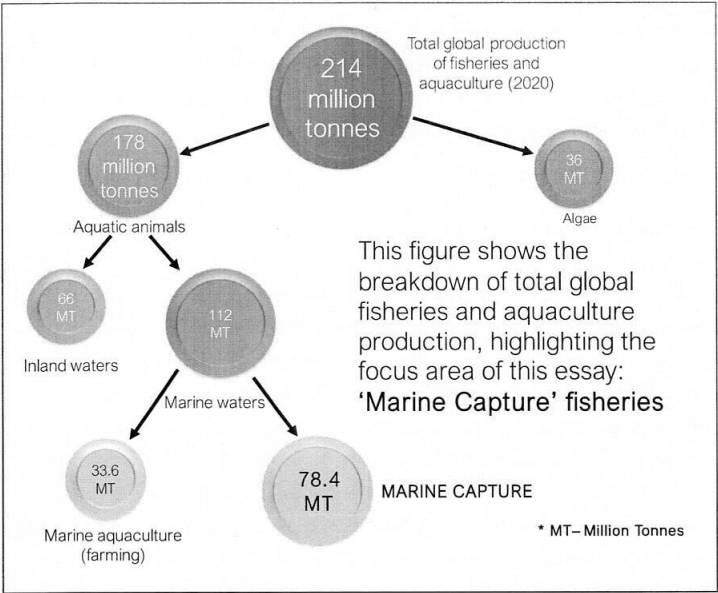
Global distribution of Marine Capture Fisheries. 80 percent of the total marine capture fish production world-wide is produced by 25 countries. The details ofthese top marine capture fish-producers are shown in Figure 2. It can be seen from this data that eight of the world's top 25 marine capture producers are in the Indian Ocean Region (IOR), collectively producing a quarter of the total global marine capture. China, of course, leads in marine capture, accounting for almost 15 per cent of the global production.

Fishing Fleets. As far as fishing boats are concerned, the FAO estimates that there were about four million fishing boats in the world in 2020, of which about two-thirds belonged to Asian countries. Additionally, there has been a trend towards larger and more powerful vessels - there are about 64,000 vessels of length greater than 24 metres which operate in marine waters15 - and more efficient fishing gear, which has resulted in enhanced catch over years. One of the reasons for the mis-match between available resources and fishing capacity - the problem of 'overcapacity' - is the large amount of money which is spent on subsidizing the fishing industry by almost all governments. Experts classify these subsidies, which amount to 35 billion USDI* or almost 30 percent of the total value of global catch, as 'beneficial', 'capacity enhancing', and 'ambiguous'. Figure 3 illustrates the wide disparity in subsidies, especially capacity-building subsidies, among a select group of countries, the effect of which is reflected in size of fishing-fleets (China leads in the size of fishing fleet with an estimated number of 564,000 vessels¹9) as well as the ability of fishers to fish in distant waters.

Threats to Marine Fisheries Resources
The threats to marine fisheries resources come from many sources, principal among which are: (1) overfishing and illegal fishing, (2) marine pollution and degradation ofmarine environment, and (3) climate change. These threats are amplified by poor regulatory and enforcement mechanisms, a lack of awareness among the fishing community and the general public (the consumers), and unsustainable methods offishing that are in use by fisherfolk. All these factors reinforce each other to form a complex and vicious cycle that ultimately leads to the depletion and degradation of fisheries resources (Figure 4).
Overfishing
As global demand for fish increases - the annual per capita consumption of aquatic food has doubled from 9.9 kg in 1960s to 20.2 kg in 2020, and is further projected to reach 21.4 kg by 2030 - the fishing industry steps up production to meet this demand. Employing new technologies, more powerful vessels, and advanced fishing gear, the industry extracts ever increasing quantities of fish from the oceans. As an illustration, 2.7 trillion fish are caught each year, which translates into five million fish caught every single minute.

A disastrous outcome of industrial fishing is the bycatch - sea animals that are caught along with edible, commercially viable species, but are discarded because there is no commercial value of these species. It is estimated that about 40 per cent of all marine life that is caught at sea, is discarded overboard as bycatch. One study brought out that 400 porpoises, 700 harbour seals, 140 grey seals and about 5000 seabirds were caught annually in the lumpsucker fishery in Iceland in the year 2013. Hundreds of thousands of fish, amphibians, marine mammals, and even sea birds are killed each year in this manner. The data for larger animals is even more shocking! Approximately 50 million sharks, and 300,000 whales, dolphins and porpoises, are killed as bycatch every year.
Illegal, Unreported, and Unregulated (IUU) Fishing
IUU Fishing represents the most prominent threat to global fishing industry. Although each of the terms - 'Illegal', 'Unregulated', and 'Unreported' -has a distinct connotation, these activities, when combined together, flout, ignore and disregard legal frameworks, jurisdictions and responsibility for sustainable fishing. Estimates indicate that IUU fishing represents up to 20 per cent of global fish yield, and costs approximately 23 billion US Dollars in lost incomes for the fishing industry. IUU fishers exploit the several weaknesses of ocean governance such as the limited capacities of many coastal States to Monitor, Control and Surveil (MCS) their maritime zones, lack of a robust legal framework to regulate fishing in Areas Beyond National Jurisdiction (ABNJ), weak or absent Regional Fishing Management Organisations (RFMOs), and limited capabilities of most governments in controlling activities beyond their jurisdiction, upon the High Seas.
Marine Pollution
Introduction of pollutants such as industrial and domestic waste, as well as oil spills, seriously impact marine ecosystems. Although most States have implemented domestic regulations to comply with international conventions and protocols, such as the MARPOL 1973, to prevent marine pollution, these efforts have had mixed results thus far. Therefore, most coastal ecosystems continue to be degraded by pollution emanating from land. Increasingly, plastic pollution in the deep-ocean has emerged as one of the most significant challenges. According to the International Union for Conservation of Nature (IUCN), 14 million tons of plastic ends up in the ocean every year, making up 80 per cent of all marine debris. Plastic in the ocean not only kills marine animals through entanglement (a phenomenon known as 'Ghost Fishing') and ingestion, but microplastics - fine plastic particles that result from breaking down of macro plastics - can find their way, through the food chain into edible marine species, thus adversely impacting, not only the health of marine animals, but also human health. The fishing industry itself is one of the major contributors of marine pollution. Between 75 to 86 per cent of the plastic floating in the Great Pacific Garbage Patch consists of discarded fishing gear, and fishing-related refuse is among the top-ten litter items in the nearshore seafloor of the seven large world socioeconomic regions.
Degradation of the Marine Environment
Overfishing, IUU fishing, and marine pollution are major anthropogenic causes of the degradation of the marine environment. Climate Change, which itself is a result of human activities, also alters the characteristics of the marine environment like temperature, salinity, nutrient level, and acidity, which in turn results in massdepletion and even extinction of marine species. Unsustainable fishing methods, such as bottom trawling, cyanide fishing and dynamite fishing, destroy fragile marine ecosystems.
Bottom trawling, considered the most destructive of all fishing practices, is like deforesting the sea-floor, but at a rate that far exceeds what is seen on land. While the estimated annual rate of terrestrial deforestation between 2015-2020 was 10 million hectares, it is estimated that bottom trawlers wipe out 150 times this area, or 1.5 billion hectares, every year. Such is the frequency and magnitude of this 'undersea deforestation' that the marine ecosystem does not have the opportunity to recover from this devastation. According to one scientific study, bottom trawling digs up and resuspends about 22 Gigatons of sediment each year, which is "approximately the same amount of all sediment being deposited on the world's continental shelves by rivers"
The threat of unsustainable practices gets amplified in coral reefs, which, although comprising a mere 0.2 per cent of the globe's seafloor, support more than 25 per cent of all known marine species. The use of poison (such as Sodium Cyanide) to capture live fish - a practice that is in vogue at least since the 1960s to supply aquariums, and increasingly, gourmet restaurants, not only kills the corals but is also a human health hazard. Similarly, the use of explosives as well as the physical pounding of the reefs (as in Muroami fishing40) not only kills non-target species, but destroys the delicate fish habitat as well, often permanently.
The rapid depletion of fish stocks results in less nutrients, by way of fish excreta, for undersea plant-life. And this, in turn, causes depletion of submarine flora. The large-scale killing of whales, sharks, seals, and other marine animals also has another effect - it causes lesser mixing of ocean's waters, which is crucial for its health. The power of sea animals moving up-and down the layers of water in the ocean is as great as the power of the winds, waves, tides and currents combined, and contributes significantly to ocean mixing and nutrient transport.
Climate Change
Global climate change manifests in the marine world in many ways - the rise in seawater temperature, sea level rise (SLR), ocean acidification, changes in salinity, are some of the effects of climate change upon the oceans. These effects impact fish stocks and the whole of marine life in two ways: firstly, it interferes with the life-cycle of marine species directly; and secondly, it degrades the marine environment, which then causes loss of biodiversity. Ocean warming causes deoxygenation (reduction in oxygen level) of seawater, which results in high levels of mortality and loss of breeding ground. Rise in sea level inundates coastal ecosystems, especially mangroves, and drastically alters coastal ecology.
Ocean acidification, which is caused by excess absorption of carbon dioxide in seawater, is another consequence of fossil fuel burning. Some estimates indicate that the acidity of the oceans might have increased by as much as 26 per cent since about 1850.This rate of acidification is roughly 10 times faster than any time in the last 55 million years. As the seawater becomes more acidic, the concentration of carbonate ions reduces, which makes calcification difficult for calcifying organisms such as oysters, clams, sea urchins, shallow water corals, deep sea corals, and calcareous plankton.Apart from interrupting and interfering with the calcium-forming processes in marine life, an increase in acidity also impacts the marine food-web, including the ability of juvenile fish to find food and locate habitat. Overall, the direct and indirect effects of climate change adversely impact fisheries resources.
Regulatory Framework for Conservation and Management of Fisheries Resources
Since the adoption of the United Nations Convention on the Law of the Sea (UNCLOS) in 1982, there has been an effort towards developing an international legal and regulatory framework - comprising both binding and non-binding instruments - for management and conservation of fisheries. Figure 5 provides a summary of these instruments, and Table 1 depicts the signatories of these international instruments among the top-25 marine fish producers in the world. By-and-large, there is a fair degree of acknowledgement of the importance of international legal instruments among these States.

Committee of Fisheries (FAO). At the United Nations, the Committee on Fisheries (COFI) of the Food and Agriculture Organization (FAO), is the nodal agency dealing with fisheries. The COFI, at its 35th session in September 2022, reported on the progress in the implementation of the Code of Conduct for Responsible Fisheries and related instruments. The report contained responses from roughly half of the 194 member States of the FAO and brought out that most of the Member States had a fisheries policy in place, and their policy, legislation, institutional framework and their operations and procedures were moderately in conformity with the Code.
| Country | Port State Measures Agreement | Compliance Agreement | Fish Stocks Agreement | Global Record |
|---|---|---|---|---|
| China | ✗ | ✗ | ✗ | ✓ |
| Indonesia | ✓ | ✗ | ✓ | ✓ |
| Peru | ✓ | ✓ | ✗ | ✓ |
| Russia | ✓ | ✗ | ✓ | ✗ |
| India | ✗ | ✗ | ✓ | ✗ |
| USA | ✓ | ✓ | ✓ | ✓ |
| Vietnam | ✓ | ✗ | ✓ | ✗ |
| Japan | ✓ | ✓ | ✓ | ✓ |
| Norway | ✓ | ✓ | ✓ | ✓ |
| Thailand | ✓ | ✗ | ✓ | ✓ |
| Malaysia | ✗ | ✗ | ✗ | ✗ |
| Philippines | ✓ | ✓ | ✓ | ✓ |
| RoK | ✓ | ✓ | ✗ | ✓ |
| Mexico | ✓ | ✓ | ✗ | ✗ |
| Chile | ✓ | ✓ | ✓ | ✗ |
| Morocco | ✓ | ✓ | ✓ | ✗ |
| Bangladesh | ✓ | ✗ | ✓ | ✗ |
| Myanmar | ✓ | ✓ | ✗ | ✗ |
| Iran | ✗ | ✗ | ✓ | ✗ |
| Oman | ✓ | ✓ | ✓ | ✓ |
| Canada | ✓ | ✓ | ✓ | ✓ |
| Argentina | ✓ | ✗ | ✓ | ✗ |
| Denmark | ✓ | ✗ | ✓ | ✓ |
| Spain | ✗ | ✗ | ✓ | ✓ |
| Iceland | ✓ | ✗ | ✓ | ✓ |
Table 1: Key International Fishing-Related Instruments Signed by the Top-25 Producers of Marine Capture Fisheries
It was further brought out that most States had developed and implemented fisheries management plans. The report also stated that nearly all members had taken steps to control fisheries operations within and outside their exclusive economic zones (EEZ). Some areas of concern that were reflected in this report pertained to bycatch and the compliance with marking ffishing gear. As far the progress on combatting IUU fishing was concerned, the Committee noted that as of April 2022, there were 70 Parties to the Port State Measures Agreement (PSMA), of which the agreement was in force in 56 percent of port States, and 48 percent of all States globally.
Regional Fisheries Management
Although there are several inter-governmental fisheries bodies world-wide, not all of them qualify as RFMOs. The term RFMO implies that an organisation, (1) has legally-binding authority to conserve and manage fish-stocks, and, (2) at least a part of the area under their jurisdiction applies to the High Seas. The FAO identifies 22 RFMOs and 24 Regional Fisheries Advisory Bodies (RFABs), which are organisations that do not have the authority to adopt legally binding conservation and management measures concerning fishing operations. Although today the entire globe is covered by one or more Regional Fisheries Bodies (RFMO or RFAB), the fish stocks continue to decline world-wide, thus raising questions over the effectiveness of these bodies in management of fisheries.
Among other challenges, it has been highlighted that "institutional challenges pertaining to membership; cumbersome decision-making processes involving issues due to consensus-based approaches and veto powers; lack of compliance; and the limited capacity and willingness of many member states to implement management measures, as well as..... omission of available scientific recommendations", also impact the effective functioning of RFMOs. It is unsurprising that some experts have opined that the priority of RFMOs - or at least of their member countries - has been first and foremost to guide the exploitation of fish stocks. They add that while conservation is part of nearly all their mandates, they were yet to demonstrate a genuine commitment to it.
The Indian Ocean Fisheries Scenario
he Indian Ocean, is a significant contributor in global fisheries, as seen by major fishing areas in the FAO database (Areas 51 and 57 in Figure 6). It represents 14.5 per cent of global marine capture harvest.54 As far as tuna and tuna-like species are concerned, the Indian Ocean Tuna Commission (IOTC) represents the second-largest tuna fisheries in the world, accounting for 32 per cent of the total global reported catch of all the tuna RFMOs combined in 2018. Yet, the FAO notes that about 30 per cent of Indian Ocean's assessed fish stocks are not fished within biologically sustainable levels. As with most other regions of the world, the Indian Ocean fisheries resources are threatened with overfishing, IUU fishing, and habitat degradation. Gaps in regulation of fishing resources, coupled with weak governance structures and lack of resources for monitoring and enforcement play a more significant role in the Indian Ocean.

IUU Fishing in the Indian Ocean
ccording to a study conducted in 2015, 16 to 34 per cent of catch in the Indian Oceanwere either illegal or unreported. China's Distant Water Fishing Fleets (DWF) have been observed to be operating in large swaths ofthe Indian Ocean. In fact, according to the data compiled by Global Fishing Watch, China's DWF operated across the globe in 2022 from the Indian Ocean to the Atlantic and the Eastern Pacific Ocean. It has been reported that more than 392 Chinese IUU fishing incidences were monitored in the Indian Ocean in 2021. In this context it is significant that the FAO notes that "of the 11.8 million tonnes reported by China in 2020, a total of 2.3 million tonnes came under 'distant-water fishery", implying the possibility that a large part of marine capture reported by China could also have come from the Indian Ocean. A standard practice by IUU fishers is to turn off the onboard Automatic Identification System (AIS) in order to avoid detection by law enforcement agencies. In one instance, for example, between 30 September 2018 and 05 October 2018, SAR imagery reported 264 vessel detections (IUU fishing) in the South China Sea, of which only 8 were broadcasting AIS. In another instance in January 2021, a fleet of Chinese fishing vessels which appeared to be fishing just outside Oman's Exclusive Economic Zone (EEZ), as indicated by their AIS broadcasts, was subsequently assessed to be operating within Oman's EEZ, thus bringing out the lacuna in AIS-based monitoring.02 Such practices make it difficult for coastal States, many of which lack the capacity to surveil their EEZ, to counter the challenge of IUU fishing.
Gaps in Regional Fisheries Management
hile a significant increase in the number of foreign fishing vessels engaging in IUU fishing in the EEZ of Indian Ocean coastal States was recorded between 2021 (61 boats) and 2022 (146 boats), 64 per cent of all 603 IUU incidents in the IOR were attributed to local fishers. Therefore, the problem of IUU fishing in the Indian Ocean is both indigenous and exogenous. But IUU fishing only representsa part of the problem of conservation of fishing resources. As brought out earlier in the essay, the fisheries resources in the IOR are threatened by a complex interplay of several factors. Management of fisheries is one such area. Within the Indian Ocean, there are three RFMOs, of which two are Tunaspecific (the IOTC and the Commission for Conservation of Southern Bluefin Tuna (CCSBT)) and one general RFMO, the Southern Indian Ocean Fisheries Agreement (SIOFA). As a consequence of specific geographic areas of competence of these RFMOs, as well as speciesspecific mandates (as is the case of IOTC and CCSBT), there exist significant geographical gaps in regulatory mechanisms in the Indian Ocean, other than for tuna and tuna-like species, and these areas remain vulnerable to unregulated fishing.64 These gaps are represented in Figure 7.

How these 'geographical gaps' — the absence of regulations for management and conservation of any kind of fish species — were exploited for unregulated fishing of squid, is brought out by a study that was conducted in the Western Indian Ocean between the years 2015 and 2019. This study concluded that in just five years, the squid fishery in this zone had grown by more than 800 percent, notably led by Chinese fishing vessels. Unregulated fishing of squid, which forms a crucial part of the tuna food-chain would, of course, adversely impact tuna and tuna-like stocks. This example is illustrative of several other gaps, such as species management, coordination, and cooperation with adjacent RFMOs, reduction of bycatch etc, in regional fisheries management in the Indian Ocean.
Regional Fishing Capacity and Extra-Regional Fishing Fleets
Two FAO Areas make up most of the Indian Ocean - Area 51 (Western Indian Ocean), and, Area 57 (Eastern Indian Ocean). Although these areas include some of the largest fish producers in the world, these areas have some peculiarities, as shown in Table 2 below.
| Area 51 — Western Indian Ocean | Area 57 — Eastern Indian Ocean | ||
|---|---|---|---|
| Coastal States | 29 | 9 | |
| Jurisdiction | National: 42% | High Seas: 58% | National: 29% | High Seas: 71% | |
| RFMOs and RFBs | RFMOs: IOTC, SIOFA, CCSBT | RFB: SWIOFC | RFMOs: IOTC, SIOFA, CCSBT | |
| Countries with largest fishing fleet | India, Pakistan, Yemen, Oman, Iran, Tanzania, Saudi Arabia, Iraq | Indonesia, India, Bangladesh, Thailand, Malaysia, Sri Lanka, Myanmar, Australia | |
| Distant Water Fishing Fleets | Taiwan, China, Japan, Malaysia, Spain | Taiwan, Japan, China, Seychelles | |
| Vessels with maximum AIS Broadcast | Bahrain, Taiwan, India, China, Japan | Australia, Taiwan, Japan, Malaysia, China, Seychelles | |
| Pattern of Fishing Vessels |
|
|
|
| Coastal fleets in this region have a high proportion of small vessels, both powered and unpowered, which are not tracked in the AIS data | |||
| The AIS data largely dominated by DWF which have a relatively high adoption of AIS compared to coastal territories. | |||
Table 2: A Comparison of Fishing Vessels Operating in the Indian Ocean with Special Reference to AIS Tracking
Two main conclusions can be drawn from Table 2:
Most of the coastal States and territories, barring a few exceptions, operate fleets of small-sized (less than 24 m) boats. This implies that they normally do not carry AIS equipment, and that their areas of operation are mostly confined within national jurisdictions.
Many countries operate Distant Water Fleets in the Indian Ocean, with larger and more capable ships. Most of these broadcast AIS, but, as brought out earlier in this essay., there are occasions where they do not.
National Actions to Preserve Fisheries
Many coastal States in the Indian Ocean implement measures to preserve fisheries. These include surveillance and monitoring of their Exclusive Economic Zones, conducting scientific studies to gather a better understanding of marine ecosystems, declaration of Marine Protected Areas (MPAs), and imposing fishing bans (especially during breeding season) which allow stocks to regenerate. For example, in 2022, 11 out of 25 IONS member countries had imposed fishing bans extending up to as much as eight months, in order to conserve fisheries resources in their EEZ (see Figure 8).

It is also noteworthy that 19 out of 22 IORA coastal State Members are part of RFMOs in their capacity as coastal States, and more than half of the IORA member states have developed national plans of action to prevent IUU fishing (NPOA-IUU)..
As far as MPAs are concerned, much needs to be done as statistics indicate that a mere 8.17 per cent of the ocean area is covered by MPAs, with 6.3 per cent of national marine areas in fully or highly protected zones. Table 3 provides an overview of MPAs in the Indian Ocean region, which illustrates the need to bring more marine areas under protection.
| Country | Marine Area Under Protection (km²) | As % of Total Marine Areas Under National Jurisdiction |
|---|---|---|
| Australia | 859,875 | 9.6 |
| Mauritius | 637,916 | 29 |
| France* | 153,406 | 1.5 |
| South Africa | 26,782 | 1.7 |
| India | 9,783 | 0.4 |
| Indonesia | 6,519 | 0.1 |
| Madagascar | 5,626 | 0.4 |
| Thailand | 4,965 | 1.7 |
| Seychelles | 2,471 | 0.2 |
| Malaysia | 2,350 | 0.5 |
| Bangladesh | 906 | 0.8 |
| Maldives | 472 | 0.1 |
| UAE | 386 | 0.7 |
| Saudi Arabia | 124 | 0.1 |
| Kenya | 63 | <0.1 |
| Comoros | 42 | <0.1 |
| Tanzania | 33 | <0.1 |
| Mozambique | 11 | <0.1 |
Table 3: Marine Protected Areas (MPAs) in Selected IOR Coastal States (* Data for France also includes French territories other than those in the Indian Ocean)
If there are many apparent lacunae in management of fisheries, the question that follows is why actions are not being initiated to bridge these shortcomings? This brings into focus the lack of capacity and capability to regulate fishing activities on part of several regional governments within their EEZ, and beyond. It is observed that many Indian Ocean countries possess extraordinarily large marine areas under their jurisdiction (EEZ), in relation to their size, economic power, and the capability of their maritime forces. These nations simply do not possess the wherewithal for a robust MCS mechanism in their maritime zones. Further, this essay also posits that not only there is a deficiency in materiel (capacity), there is also a lack of expertise in management techniques (capability) such as collation and interpretation of data, the training standards of maritime law enforcers, scientific and technical know-how, to name a few. Therefore, there is a need to supplement the capacity and capability of these States, in addition to reinforcing regional mechanisms.
What Can Be Done?
Fisheries resources are under severe stress because of a multitude of factors which range from economic compulsions, lack of scientific methods and data, jostling for resources, anthropogenic factors such as pollution and climate change, and the apparent reticence on part of many governments to implement stringent measures to control and regulate fishing. The last part of this essay will endeavour to suggest some measures that could be implemented in order to conserve fisheries in the Indian Ocean.
International and Regional Measures
At the political level, it is important for nations to recognize the need for preservation of the marine environment, including marine flora and fauna. The commitment to the UN SDG 14 (Life Below Water), as well as initiatives such as the Leaders' Pledge for Nature, brings into focus the urgent need for conservation of biodiversity. This should further translate to 'actions' that are aimed at preservation of, among other things, fisheries, and marine resources. The Indo-Pacific Oceans Initiative (IPOI) is one such forum. Initially articulated by Mr Narendra Modi, the Prime Minister of India at the East Asia Summit on 04 November 2019, the IPOI seeks to galvanise international efforts in the Indo-Pacific to ensure a 'holistic' approach to maritime security. Two of its 'pillars' or 'spokes' are focussed on 'Maritime Resources' and 'Marine Ecology' (see Figure 9), which would be able to address the problem of depleting fish resources in toto. Because the IPOI does not envisage creation of any additional structures, but aims instead at leveraging existing regional cooperative mechanisms, it would be ideal if existing organisations such as the IORA, IONS, the Indo-Pacific Parks Initiative etc can focus their attention on this issue. It can also be seen that, currently only a few countries have joined the IPOI. It is opined that greater international participation in this initiative could be beneficial for the region, especially in preservation of fisheries.

Although fisheries management is a priority area for the Indian Ocean Rim Association, and even as the 1ORA's Outlook on the Indo-Pacific acknowledges that "promotion, conservation, sustainable use, and management of marine resources in the Indo-Pacific region" are among its objectives, it is recommended that IORA must do more in this area. More specifically, the IORA Fisheries Support Unit (FSU), which spearheads its efforts to identify and discuss key fisheries-related issues must emerge as a regional centre for knowledge sharing, capacity building and addressing strategic issues in the fisheries and aquaculture sectors. Among other ways in which this needs to be done, is the sharing of its knowledge resources in the public domain.
Regional efforts must also focus on capacity-building and capability enhancement of smaller coastal nations. Joint patrolling and MCS mechanisms could also be instituted. Initiatives such as the Coral Triangle Initiative for Coral Reefs, Fisheries and Food Security (CTI-CFF), which is a partnership between Indonesia, Malaysia, Papua New Guinea, the Philippines, Solomon Islands and Timor Leste, can also be emulated in the IOR.
National Measures
The steps that can be taken at the national level have already been alluded to earlier in this essay. These include: greater integration and information sharing with RFMOs, ratification of international legal instruments aimed at management of fisheries, reducing subsidies in the fishing sector, imposition of fishing moratoriums in their maritime zones, increasing the marine areas under protection, awareness programmes among fishers, appropriate import controls for sustainably fished products, strengthening surveillance of EEZ and empowerment of maritime law enforcement agencies.
Role of IONS
IONS, as the sole pan-Indian Ocean platform for cooperation among IOR navies, can contribute in good measure to preservation of fisheries resources. Some of the recommendations for IONS are:
- Establish a new 'Working Group' on Fisheries Preservation. This group should work towards deterring and preventing IUU fishing in the Indian Ocean by sharing of information with RFMOs, the IORA FSU, and governments of coastal States.
- Information Fusion. Four important Information Fusion Centres are being operated in the Indian Ocean. Of these, three IFCs are in member countries - India, Seychelles and Singapore; and the fourth is in Madagscar, which is an observer. It is suggested that these four IFCs must deepen their linkages in order to have better and more accurate information about IUU fishing in the region.
- The Information Sharing and Interoperability Working Group (ISIWG) of the IONS should make focussed efforts towards collating information on IUU fishing, especially through correlation of AIS track data with maritime patrols carried out by IONS members. This group must also cooperate with RFMOs in the Indian Ocean and develop mechanisms to exchange information on fisheries.
- IONS could also evolve a Standard Operating Procedure (SOP) on how to identify IUU fishing vessels based on their markings and behaviour, as well as responses when such vessels turn off AIS broadcasts. Additionally, IONS members could discuss application of technologies such as the Visible Infrared Imaging Radiometer Suite (VIIRS)76 and Radio Frequency analysis. Such technological applications could also be provided to coastal States on request.
- IONS exercises, which have till now been focussed on HADR, should transition to wider roles such as biodiversity preservation missions. The cooperation between the French Navy and French Biodiversity Agency (OFB), in which the overseas support and assistance vessel (BSAOM) Dumont D'Urville was made available to the Agoa Sanctuary and Martinique Natural Marine Park, is an apt example of how this could be done. Another example is the Royal Australian Navy's approach to the marine environment, which is embodied by the various measures it has adopted to minimise the impact of naval exercises on marine biodiversity.
A Holistic Approach
Because global fisheries are threatened by several different factors, their conservation requires a holistic approach - one that harmonises several 'thrust-lines', as depicted in Figure 10. Not only must governments institute measures to prevent over-exploitation of marine resources by their fishing industries, there needs to be an international coalition on preservation of fisheries, which would include greater participation in, and compliance, with regional and international conservation mechanisms. Regional Fisheries Bodies (RFMOs and RFABs) must address the gaps in fisheries management and regulation in ABNJ. The fishing industry must itself adopt sustainable practices, including transition to aquaculture and cage farming of fish. Proper marking of fishing gear, use of target-specific fishing methods, eschewing bottom-trawling, not discarding gear at sea are other steps that must be adopted.

Non-Governmental Organisations (NGOs) and think-tanks must be engaged to support awareness programmes as well as to collect and analyse fisheries related data. Organisations such as the Sea Shepherd, which has engaged in some controversial 'direct-action' campaigns in the past, appear to have an increasing role in preservation of fisheries, especially when acting 80 in cooperation with governments. Because the ability of governments to allocate law enforcement resources for monitoring their EEZ (as also ABNJ areas), is increasingly getting limited, contracting such tasks to NGOs might be a viable solution, especially through the use of space-based technologies and unmanned platforms. Therefore, it might be a good idea to harmonise such envisaged roles of NGOs with existing international law.
At the other end of the spectrum lie the consumers and the society, who must be made aware of the benefits of wise dietary preferences, the 3 Rs, as well as maintaining an elevated sense of responsibility towards the environment. While even a minor transition to a plant-based diet would indeed reduce the demand for fish, the 'de-glamourisation' of luxury food products such as shark-fin soup, whale meat, oysters and caviar would also go a long way in fisheries conservation. Public opinion, especially in the era of wide-spread use of social media, is a powerful tool that must be leveraged to shape industry behaviour and government policies so that fisheries resources can be conserved and regenerated.
Conclusion
Although this essay has dealt with the subject of preservation of fisheries resources, it is amply clear that fisheries can be conserved if, and only if, the marine environment is preserved. This is an approach that is dictated by common-sense.
It is a different matter that this request was not heeded, and the Thames Estuary has long ceased to be a fishery and biodiversity hotspot. Traditional fishing methods the world over, too, had recognised the need for maintaining a fine balance with the environment. Unfortunately, even as sustainability evolves as a buzz-word in modern economic lexicon, there is little evidence, if any, that humanity's new methods of exploitation of natural resources will sustain Nature's delicate equilibrium in future.
Mankind is still making startling discoveries about the oceans, whose depths and remotest recesses are yet to be explored, and fully understood. What is currently known for sure is that the oceans sustain life upon Earth. As the planet's mammoth climate-control machines, oceans recycle both matter (carbon dioxide and oxygen) and energy (heat), which are critical for life to exist. They store 93 per cent of the carbon, and produce 50 to 85 per cent of oxygen on the planet. Marine species, including fish and other aquatic animals which are harvested for food and other purposes, play an important role in helping oceans maintain this cycle. This essay subscribes to the generally held view that global fisheries are under serious threat. Since the ocean ecosystem is an extremely inter-connected and inter-dependent web, our conservation efforts need to adopt a 'holistic' approach, because, piecemeal redressal of any single issue will simply not work.
(Word Count: 5947, excluding footnotes and bibliography)
Bibliography
Primary Sources
- Australian Government, Department of Climate Change, Energy, the Environment, and Water, 'Australia's International Marine Conservation Engagement', https://www.dcceew.gov.au/environment/marine/international-activities
- Food and Agriculture Organization of the United Nations, The State of World Fisheries and Aquaculture 2022: Towards Blue Transformation, Rome, FAO, https://doi.org/10.4060/cc0461en
- Food and Agriculture Organization of the United Nations, Illegal, Unreported and Unregulated (IUU) fishing, https://www.fao.org/iuu-fishing/international-framework/en/
- FAO, Committee of Fisheries, Thirty-Fifth Session, 'Highlights ofthe Progress in the Implementation of the Code of Conduct for Responsible Fisheries and Related Instruments' https://www.fao.org/3/nj568en/nj568en.pdf
- Government of France, Permanent Mission of France to the United Nations. https://onu.delegfrance.org/IMG/pdf/leaders_pledge_for_nature_27.09.20.pdf
- Indian Ocean Rim Association, IORA's Outlook on the Indo-Pacific, https://www.iora.int/media/24442/indo-pacific-outlook.pdf
- International Maritime Organisation, '2012 Cape Town Agreement (Explained)', https://sway.office.com/pGZcJtkSuHNxDzy5?ref=Link
- Indian Navy, IFC-IOR, 'Annual Report 2022', https://www.indiannavy.nic.in/ifcior/static/data/reports/annual/3.%20IFC-IOR%20Annual%20Report%202022.pdf
- Government of the United States, 'What is Ocean Acidification?', https://oceanservice.noaa.gov/facts/acidification.html
- National Ocean Service, National Oceanic and Atmospheric Administration, The National Archives of the United Kingdom, The Cod Wars, The Cabinet Papers, https://www.nationalarchives.gov.uk/cabinetpapers/themes/cod-wars.htmt
- Royal Australian Navy, 'Navy and the Environment', https://www.navy.gov.au/environment
- United Nations Environment Programme, 'Stopping Fish Bombing', 21 February 2019, https://www.unep.org/news-and-stories/story/stopping-fish-bombing
- United States Geological Survey, 14 March 2016, https://www.usgs.gov/news/national-news-release/what-drag-global-impact-bottom-trawling
Books and Journals (including online publications)
- Ásmundsson, Stefán, 'Regional Fisheries Management Organisations (RFMOs): Who are they, what is their geographic coverage on the high seas and which ones should be considered as General RFMOs, Tuna RFMOs and Specialised RFMOs?", Convention on Biological Diversity, https://www.cbd.int/doc/meetings/mar/soiom-2016-01/other/soiom2016-01-fao-19-en.pdf
- Baum, Julia K. Baum and Myers, Ransom A., et al, 'Collapse and Conservation of Shark Populations in the Northwest Atlantic', Science, 17 January 2003, Vol 299, Issue 5605, doi: 10.1126/science. 107977
- Chauhan, Pradeep, Indo-Pacific Oceans Initiative (IPOI): What it is, what it is not, and why it is crucial', lecture.
- Clover, Charles, 'Dogger Bank is About More Than Shipping Forecasts: it Shows How We Can Rewild Our Seas', The Guardian, 13 June 2022, https://www.theguardian.com/commentisfree/2022/jun/13/britain-rewilding-north-seadogger-bank-biodiversity
- Crispino, Michael, '5 Ways Harmful Fisheries Subsidies Impact Coastal Communities', World Wildlife Fund, 21 November 2019, https://www.worldwildlife.org/stories/5-waysharmful-fisheries-subsidies-impact-coastal-communities
- Cullis-Suzuki, Sarika and Pauly, Daniel, 'Failing the High Sea: A Global Evaluation Of Regional Fisheries Management Organizations', Marine Policy, September 2010, 34(5):1036-1042, DOI:10.1016/j.marpol.2010.03.002
- Heidrich, Kristina N. and Juan-Jordá, Maria José, et al, 'Assessing Progress in Data Reporting by Tuna Regional Fisheries Management Organizations', Fish and Fisheries, Vol 26, Issue 6, November 2022, https://doi.org/10.1111/faf.12687
- Hosch, Gilles, 'Technical Assistance to IORA for the Implementation and Coordination of Iora Action Plan on Fisheries, Aquaculture and Marine Environment', April 2021, p. 17, https://www.iora.int/media/24327/io349rt04a-iora-report_analysis-of-measures-to-combat-iuu-fishing-final-v2-cofrepeche-min.pdf
- Katija, Kakani and O Dabri, John, 'A Viscosity-Enhanced Mechanism for Biogenic Ocean Mixing', Nature, 2009 Jul 30;460(7255):624-6. doi: 10.1038/nature08207, https://pubmed.ncbi.nlm.nih.gov/19641595/
- Lebreton, L., Royer, SJ., Peytavin, A. et al. Industrialised fishing nations largely contribute to floating plastic pollution in the North Pacific subtropical gyre. Sci Rep 12, 12666 (2022). https://doi.org/10.1038/s41598-022-16529-0
- Løbach, Terje and Petersson, Matilda et al, 'Regional Fisheries Management Organizations and Advisory Bodies Activities and Developments, 2000–2017', FAO Fisheries and Aquaculture Technical Paper No. 651. Rome, FAO, p. 8. https://doi.org/10.4060/ca7843en
- Marine and Freshwater Research Institute, Bycatch of Seabirds and Marine Mammals in Lumpsucker Gillnets 2014-17, March 2018, https://www.hafogvatn.is/static/files/skjol/techreport-bycatch-of-birds-and-marine-mammalslumpsucker-en-final-draft.pdf
- Mayorga, Juan 'The Overlooked Impact of Bottom Trawling', Global Fishing Watch, 22 April 2021, https://globalfishingwatch.org/research/the-overlooked-impact-of-bottomtrawling/
- Morales-Caselles, Carmen et al, 'An Inshore-Offshore Sorting System Revealed from Global Classification of Ocean Litter', Nature Sustainability, Vol 4, June 2021, p. 490, https://archimer.ifremer.fr/doc/00700/81230/85530.pdf
- Morgan, L.E. and Norse E.A. et al, Why the World Needs a Time-Out on High Seas Bottom Trawling, The Deep-Sea Conservation Coalition, June 2005, p. 4-6, https://marineconservation.org/archive/mcbi/TimeOut_english.pdf
- Ogawa, Mervin and Reyes, Joseph Anthony L, Assessment of Regional Fisheries Management Organizations Efforts toward the Precautionary Approach and Science-Based Stock Management and Compliance Measures', Sustainability 2021, 13(15), 8128; https://doi.org/10.3390/su13158128
- Poling, Gregory B., 'Illuminating the South China Sea's Dark Fishing Fleets', Center for Strategic and International Studies, https://ocean.csis.org/spotlights/illuminating-thesouth-china-seas-dark-fishing-fleets
- Sumaila, U Rashid and Ebrahim, Naazia et al, 'Updated Estimates and Analysis of Global Fisheries Subsidies', Marine Policy, Volume 109, November 2019, https://doi.org/10.1016/j.marpol.2019.103695
- Scholaert, Frederik 'Chinese Distant Water Fishing Fleet', European Parliamentary Research Service, https://www.europarl.europa.eu/RegData/etudes/BRIE/2023/747900/EPRSBRI(2023)747900.pdf
- Schuhbauer, Anna and Skerritt, Daniel J. et al, ‘The Global Fisheries Subsidies Divide Between Small- and Large-Scale Fisheries', Frontiers in Marine Science, 29 September 2020, Sec. Marine Fisheries, Aquaculture and Living Resources, Volume 7-2020, https://doi.org/10.3389/fmars.2020.539214
- Taconet M., Kroodsma D. and Fernandes J. A., Global Atlas of AIS-based Fishing Activity - Challenges and Opportunities, Rome, FAO, pages 245-263. (Also available at www.fao.org/3/ca7012en/ca7012en.pdf )
- Watling, Les and Norse, Elliot, 'Disturbance of the Seabed by Mobile Fishing Gear: A Comparison to Forest Clearcutting', Conservation Biology, Vol 12, No 6, December 1998, р. 1180-1197, https://marine-conservation.org/archive/mcbi/Watling&Norse1998.pdf
Websites and Other Web Resources
- 'Keeping tabs on China's Murky Maritime Manoeuvres', The Economist, 15 August 2023, https://www.economist.com/china/2023/08/15/keeping-tabs-on-chinas-murkymaritime-manoeuvres
- Marine Protected Areas, Protected Planet, https://www.protectedplanet.net/en/thematicareas/marine-protected-areas
- Marine Protection Atlas, Marine Conservation Institute, https://mpatlas.org/countries/list/
- Navigating the Waves: Unlocking Insights through Maritime Data Comparison, HawkEye360 https://www.he360.com/resource/unlocking-the-future-of-maritimesurveillance-hawkeye-360s-space-based-rf-technology/
- Sanctuary for Marine Mammals, Agoa, 'Collaboration with French Navy', https://sanctuaire-agoa.fr/editorial/collaboration-french-navy
- How Dangerous Is It to Use Cyanide to Catch Fish?, Scientific American, 10 August 2011, https://www.scientificamerican.com/article/cyanide-fishing/
- Deforestation has slowed down but still remains a concern, new UN report reveals, UN News, 21 July 2020, https://news.un.org/en/story/2020/07/1068761
- https://seashepherd.org/
- https://www.seaspiracy.org
- https://www.fao.org
- https://wwf.panda.org
- https://www.unescwa.org
- https://www.iucn.org
- https://coastadapt.com.au
- https://www.aninews.in
Audio Visual Media
- Seaspiracy, documentary film, Netflix. Also see https://www.seaspiracy.org/facts
